
Doctoral Programme
Geography Education — Universitas Pendidikan Indonesia
Introduction
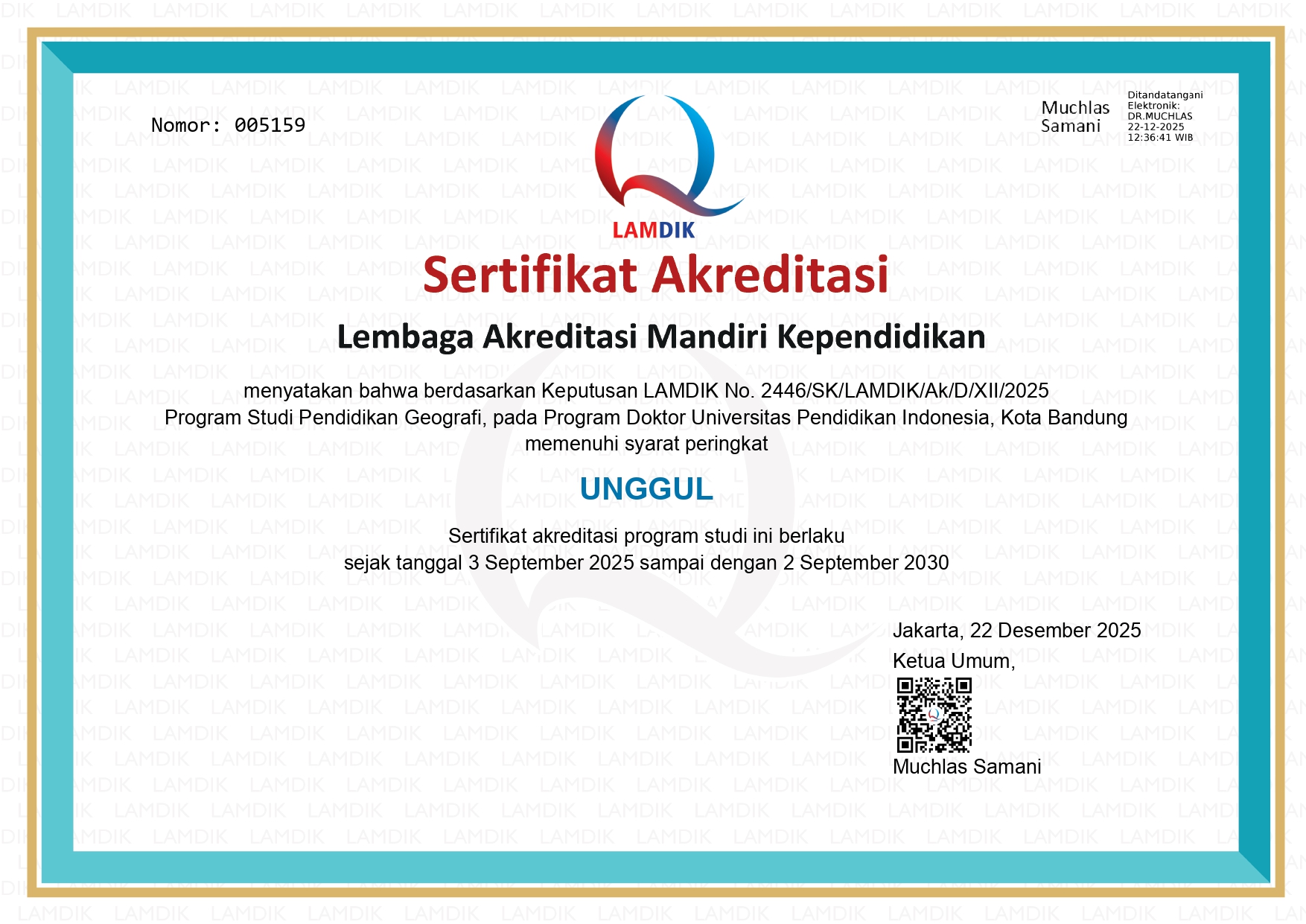
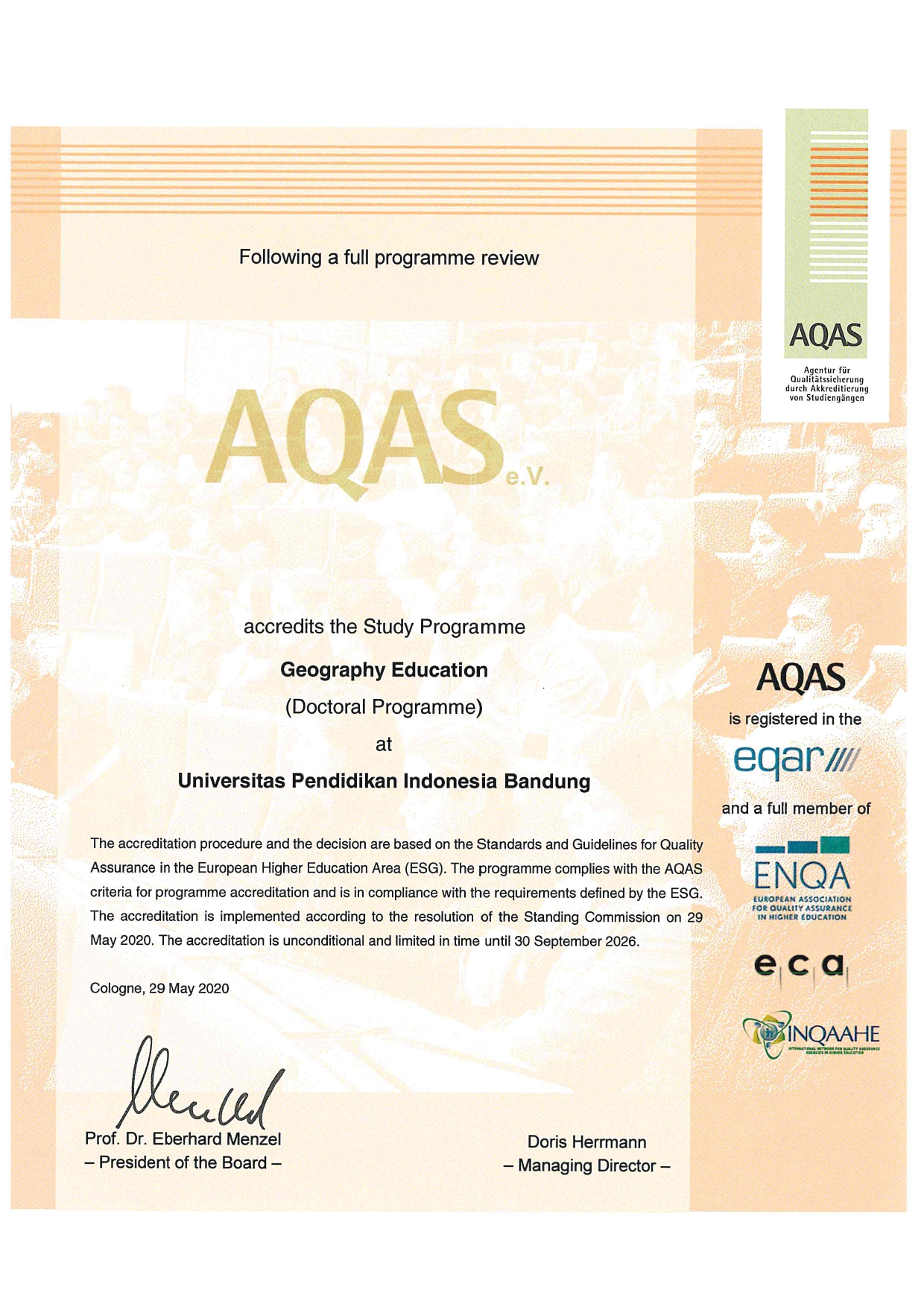
In accordance with DIKTI decree No. 4350/UN40/HK/2014, the Doctoral Program (S3) in Geography Education at Universitas Pendidikan Indonesia (UPI) was officially established on June 17, 2014. Its objective is to cultivate academics who are capable of generating new knowledge through interdisciplinary research to address complex issues in geography education and make a meaningful contribution at both the national and international levels. This program, which serves as the premier program of the Faculty of Social Science Education (FPIPS), is crucial and prestigious in its demonstration of UPI's ability to provide advanced doctoral education that is research-intensive. This program directly enhances UPI's reputation by producing globally competitive scientists and researchers. Specifically, the university's profile is strengthened by the achievement of "EXCELLENT" accreditation from BAN- PT/LAMDIK and international accreditation from AQAS, which demonstrates its commitment to meeting global academic quality standards. Consequently, this doctoral program is a critical element of UPI's strategy to establish itself as a world-class and comprehensive research university.
Academic Staff
Programme Structure
Doctoral Programme Curriculum Structure and ECTS Conversion
| No. | Educational Component | Credit Load (SKS) | ECTS | Description / Course Examples |
|---|---|---|---|---|
| 1 | General Courses | 2 SKS | 3 ECTS | Philosophy of Science (2 SKS) — Compulsory |
| 2 | Development of Study Program Expertise | 12–14 SKS | 18–21 ECTS |
|
| 3 | Development of Skills in the Field of Expertise | 8 SKS | 12 ECTS |
|
| 4 | Advanced Competence Strengthening | 20 SKS | 30 ECTS |
|
| TOTAL | 42–44 SKS | 63–66 ECTS | Overall Doctoral Programme Credit Load | |
Curriculum
The Doctoral Program in Geography Education curriculum integrates advanced philosophy of geography education, pedagogical content knowledge, interdisciplinary research, and scientific publication to develop scholars capable of producing original and impactful contributions in geography education.
Graduate Learning Outcomes (CPL)
- Graduates are expected to demonstrate scientific, educational, and religious attitudes and behaviors based on academic norms and ethics.
- Graduates are able to develop spatial intelligence and conduct original, creative, and scientifically validated research through mastery and critique of geography education philosophy, theories, approaches, and principles.
- Graduates develop pedagogical and geographical content knowledge (Pedagogical Content Knowledge) to address educational and geographical learning challenges.
- Graduates understand scientific procedures, ethics, and publication systems for communicating research ideas and findings through oral and written forms.
- Graduates are able to integrate life skills, technology mastery, innovation, and lifelong learning into academic and professional development.
- Graduates are capable of discovering and developing new theories, concepts, and scientific contributions through interdisciplinary, multidisciplinary, and transdisciplinary research.
- Graduates are able to analyze, design, manage, conduct, and lead geography education research individually and collaboratively.
- Graduates are able to communicate research findings effectively through scientific forums and journals to achieve national and international recognition.
Curriculum Orientation
| Curriculum Component | Implementation in the Program |
|---|---|
| Philosophy of Geography Education | Developing critical understanding of philosophy, theories, and principles of geography education to cultivate spatial intelligence. |
| Pedagogical Content Knowledge | Strengthening pedagogical and geographical content knowledge to solve educational and learning challenges in geography. |
| Advanced Research and Innovation | Designing, managing, and leading original research using interdisciplinary, multidisciplinary, and transdisciplinary approaches. |
| Scientific Communication and Publication | Preparing students to communicate and publish research findings through scientific forums and journals at national and international levels. |
The curriculum structure of the study program demonstrates that each course has its own specific learning outcomes, which contribute to the achievement of programme-level Graduate Learning Outcomes (CPL).
Accreditation
Admission
Admission information for the Doctoral Programme, including RPL pathways and registration procedures.
Apply Now