
Undergraduate Programme
Geography Education — Universitas Pendidikan Indonesia
Introduction
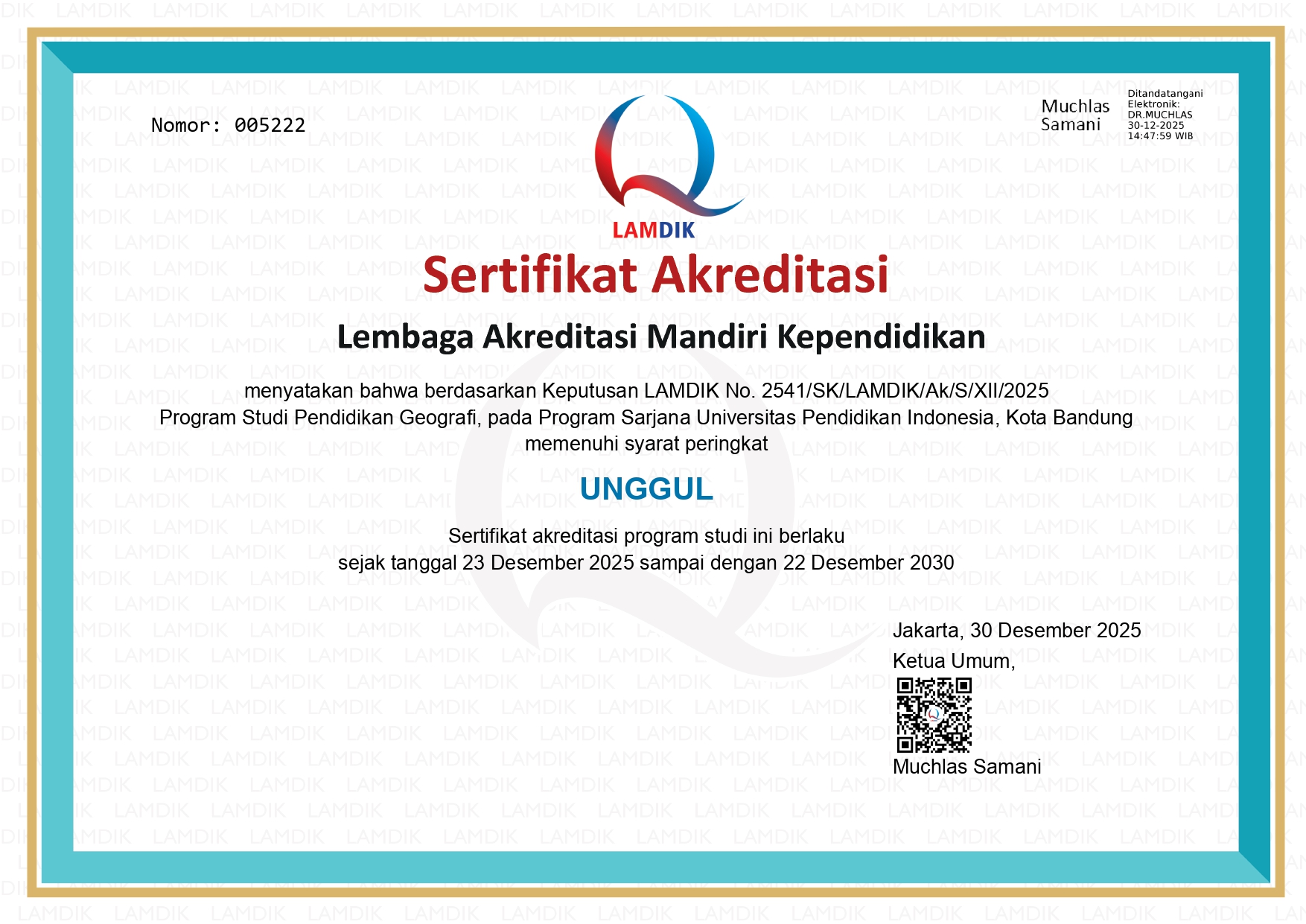
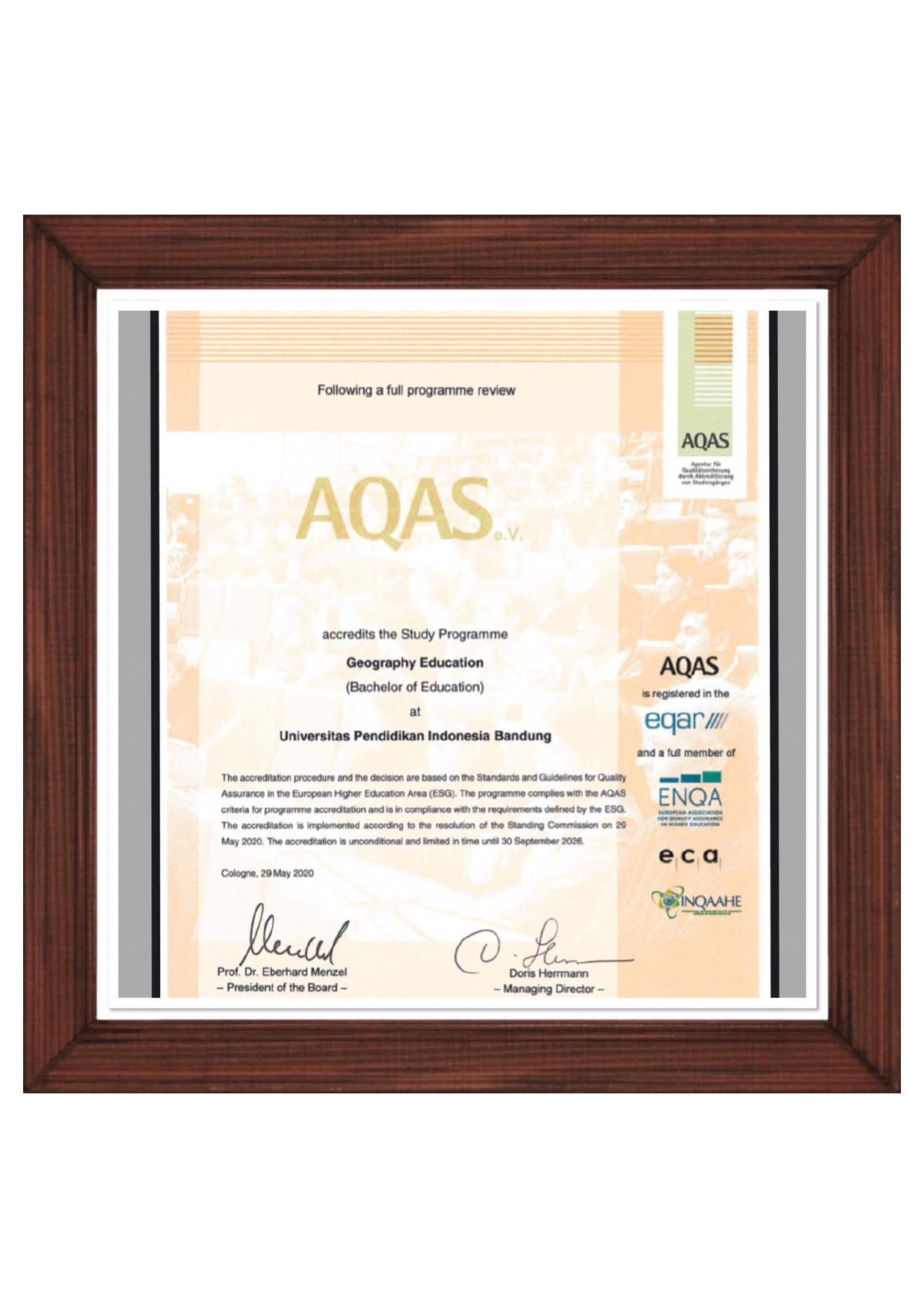
The Geography Education Study Program was established in 1961 by Prof. Dr. Phil. Supardjo. The accreditation status of the study program is based on Decree Number 2541/SK/LAMDIK/Ak/S/XII/2025 dated December 30, 2025, and in 2020 it obtained an “Excellent” accreditation following accreditation by AQAS. The graduate profile of the program includes prospective Geography teachers and Geography graduates. The Geography Education Study Program aims to produce graduates who are competent as prospective teachers and geography scholars who are excellent, adaptive to the development of science and technology, and capable of addressing educational challenges and spatial dynamics at various scales. The program plays a strategic role in preparing professional and innovative educators to enhance the quality of geography learning. To support this objective, the program continuously strengthens its academic quality through a research-based curriculum, the utilization of geospatial technologies, and the integration of scientific values and character development. The achievement of “Excellent” accreditation and international recognition affirms the program’s commitment to higher education quality standards and reinforces its position as a leading program at both national and international levels.
Academic Staff
Programme Structure
- Core Courses
- Research Methodology
- Dissertation Proposal
- International Publication
- Dissertation Examination
Curriculum
The Geography Education Study Program curriculum integrates educational theory, geography science, geospatial technology, fieldwork, and teaching practicum to develop professional, analytical, and applied competencies in geography education.
Domain Learning Outcomes (CPL)
- Graduates are expected to demonstrate scientific, educative, and religious attitudes and behaviors based on academic norms and ethics.
- Students are able to analyze geosphere phenomena, regional characteristics, environmental resources, and sustainable development issues using geographic theories and approaches.
- Students are able to formulate, process, analyze, and present geosphere data using geospatial technology for geography learning and research.
- Students are able to design, implement, and evaluate geography learning systems, media, and technology-based learning models.
- Graduates are expected to apply logical, critical, systematic, and innovative thinking while integrating technology, career development, and lifelong learning skills.
Curriculum Components
| Curriculum Component | Implementation in the Program |
|---|---|
| Education Courses | Students learn lesson planning, geography teaching strategies, learning assessment, and microteaching to prepare professional teaching competencies. |
| Geography Science Courses | Strengthening concepts in physical geography, human geography, and regional geography as a foundation for understanding geospatial phenomena. |
| Practice-Based Learning | Fieldwork, geography laboratory practicums, mapping projects, and student research to develop analytical and applied skills. |
| Teaching Practicum (PPL) | Students gain direct teaching experience in schools to develop pedagogical and professional competencies. |
The curriculum structure of the study program demonstrates that each course has its own specific learning outcomes, which contribute to the achievement of programme-level Graduate Learning Outcomes (CPL).
Accreditation
Admission
Admission information for the Undergraduate Programme, including RPL pathways and registration procedures.
Apply NowInternational Admission
Admission information for the Undergraduate Programme, including RPL pathways and registration procedures.
Apply Now