

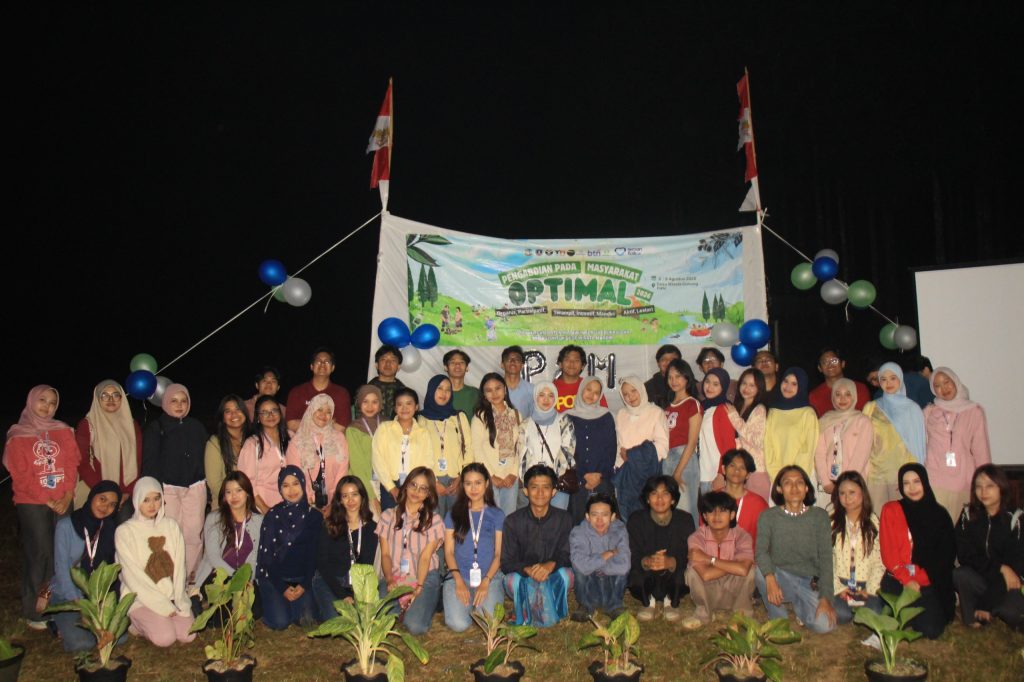
The Tourism Marketing Management Student Association (HIMA MPP) of the Indonesia University of Education (UPI), through its Corporate Social Responsibility (CSR) Division, carried out a 2026 Community Service (P2M) activity in Gununghalu Village, Gununghalu Subdistrict, West Bandung Regency, West Java. Under the name OPTIMAL (Organized, Participatory, Skilled, Innovative, Independent, Active, Sustainable) and with the theme “Optimizing Local Potential through Education and Synergy for a Self-Sustaining Tourism Village,” this event took place over four days, from Thursday, August 6, to Sunday, August 9, 2026.
P2M 2026 was held as a form of student commitment and tangible contribution to the community, particularly in supporting the sustainable development of village potential. This event was motivated by the recognition that there remains untapped potential within rural communities that can be developed more effectively in the areas of economy, education, health, and the environment. Through various programs designed to be both educational and participatory, HIMA MPP UPI seeks to encourage communities to develop local potential as part of strengthening self reliant and sustainable tourism villages.
Over the course of the four-day event, students and the residents of Gununghalu Village participated in a variety of activities. The program included free health screenings, natural disaster mitigation education, joint educational sessions with students from SDN Tangsi Jaya, digital marketing workshops and MSME case studies, the production of promotional videos for tourist destinations and MSMEs, and the distribution of coffee seedlings to the community. These activities were designed to provide benefits while supporting the development of local potential in various aspects.
Detasya Cahya, Deputy Chair of the P2M 2026 Executive Committee, noted that the program provided an opportunity for students to interact and learn directly with the community. Throughout the event, community members showed great enthusiasm in participating in the various programs, particularly the SME workshops, health screenings, and educational sessions. These interactions also served as a platform for students and community members to share knowledge and experiences with one another.
This event involved various parties, ranging from the P2M 2026 organizing committee and volunteers, the residents of Gununghalu Village, MSME operators, students from SDN Tangsi Jaya, village officials, sponsors, media partners, to other parties who supported the event’s implementation. This collaboration was a key factor in ensuring the smooth running of the entire four-day program.
The implementation of P2M 2026 not only benefited the community but also served as a learning opportunity for Tourism Marketing Management students to directly apply the knowledge gained in class within the community. Through this event, students gained experience in building communication, managing programs, and understanding the needs and potential of the community in the context of developing a tourism village.
Overall, the P2M 2026 series was successfully carried out and received a positive response from the community of Gununghalu Village. Through the activities that have been carried out, HIMA MPP UPI hopes that the relationships and cooperation established with the community, the village government, and various other parties can be maintained. In addition, it is hoped that the programs provided will offer sustainable benefits and become part of the effort to develop the potential of Gununghalu Village toward becoming a more self reliant tourism village.
The implementation of the 2026 P2M program also supports the Sustainable Development Goals (SDGs), specifically SDG 4: Quality Education through educational activities for the community and students; SDG 8: Decent Work and Economic Growth through capacity building for MSMEs and the promotion of local potential; and SDG 11: Sustainable Cities and Communities through efforts to support the development of self-reliant and sustainable tourism villages. Health checkups and health education activities are also aligned with SDG 3: Good Health and Well Being, while the distribution of seedlings and attention to environmental aspects support SDG 15: Life on Land. Thus, the P2M program organized by HIMA MPP UPI serves as a tangible example of collaboration between students and the community in creating impactful and sustainable social contributions.
Author: Riani Rizki Oktaviani