
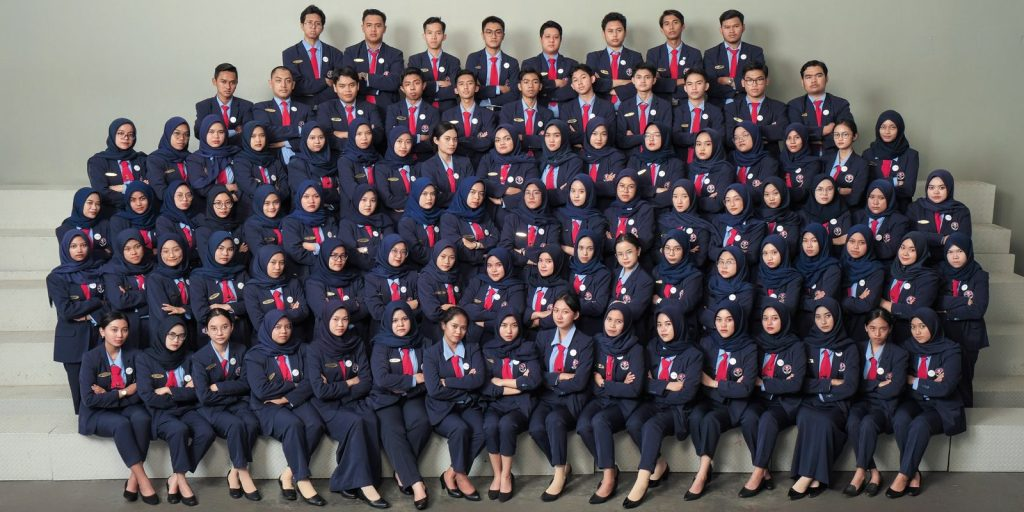
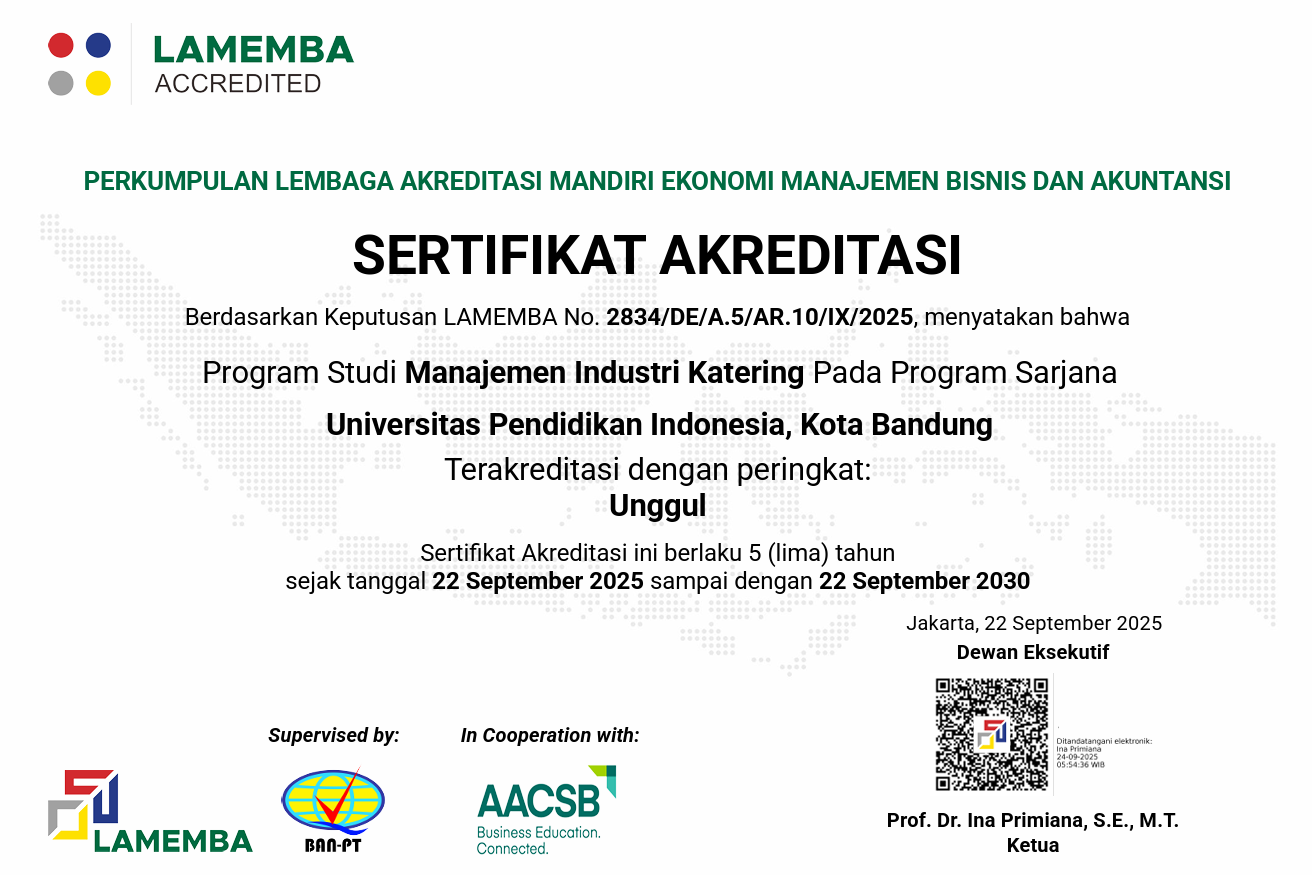
The Catering Industry Management Study Program (Prodi MIK) was established in 2005 based on the Rector's Decree of UPI No. 1338/J33/PP.03.02/2005 dated March 16, 2005. Over time, the MIK program has undergone curriculum revisions in 2006, 2010, 2018, and 2023. The program was certified in 2024 by ACQUIN (The Accreditation, Certification and Quality Assurance Institute), a recognized international accreditation agency based in Germany. Furthermore, the MIK study program has achieved an "Unggul" (Excellent) accreditation from LAMEMBA based on Decree No. 2834/DE/A.5/AR.10/IX/2025, which is valid until September 22, 2030. The Catering Industry Management program has a vision and mission determined based on the faculty and university's vision and mission, which are then developed in accordance with the program's objectives and expected outcomes. A comprehensive analysis of internal and external factors that could serve as potential strengths or constraints for the program's development is also conducted to achieve a forward-thinking vision and mission. The discussion on the vision and mission is conducted by considering the learning outcomes of graduates of the Catering Industry Management Study Program (MIK) in line with the expected competency standards for a Bachelor of Tourism (S.Par). The vision of the Catering Industry Management Study Program (MIK) is as follows:
“A Pioneering and Excellent Program in the Field of Catering Industry Management Based on the Tri Dharma Principles by 2030 at the National and International Levels”
The vision of the MIK program as a Pioneering and Excellent Program in the Field of Catering Industry Management Based on Research by 2030 is a manifestation of the vision of UPI and FPIPS. As the first tourism program in Indonesia to produce Bachelor's degree graduates, the MIK program demonstrates UPI's status as a pioneering university. The multidisciplinary nature of tourism studies is also reflected in the strengthening of academic disciplines, technology, and professional expertise across all fields within FPIPS, enabling the program to excel and lead in its field.
In general, the vision signifies that the Catering Industry Management program has established itself as a leading tourism program in producing graduates, scientific works, research, and community service activities related to planning, management, and development in the catering industry. Indicators of excellence are assessed based on academic aspects (student affairs), research (scientific works), and community service.
VISION
“To be a pioneering and outstanding program in the field of catering industry management based on the Tri Dharma principles by 2030 at the national and international"
MISSION
- To provide education to produce professional, trustworthy, and capable graduates in tourism who can develop the potential of natural resources, human resources, and technology.
- To conduct research and development in the field of catering industry management.
- Conducting community service activities in the field of catering industry management that align with the needs and developments of society, science, and technology.
- Expanding access and networks with national and international stakeholders in the tourism sector.
Accreditation Certificate from ACQUIN

Accreditation Certificate from LAMEMBA
Accreditation Certificate from ACQUIN
Quality Assurance
Quality Assurance at Universitas Pendidikan Indonesia (UPI) is a system designed to ensure and continuously improve the quality of education, research, and community service across all units and study programs within UPI.
Quality Assurance Policy and Foundation
UPI implements the Internal Quality Assurance System (Satuan Penjaminan Mutu Internal) and the External Quality Assurance System (Satuan Penjaminan Mutu External) in accordance with national regulations, such as the Regulation of the Minister of Research, Technology, and Higher Education (Permenristekdikti) No. 62 of 2016 on the Higher Education Quality Assurance System and the National Standards for Higher Education (SN Dikti).
Quality Assurance Organizational Structure
The University Quality Assurance Agency (SPM) is responsible for formulating policies, developing quality standards, coordinating implementation, monitoring, evaluating, and reporting on quality assurance.
The Study Program Quality Assurance Team (SKM) and Faculty Quality Assurance Unit (GKM) are tasked with developing unit-level quality standards, conducting evaluations, and ensuring activities are carried out in accordance with established standards.
At the Study Program level, the Catering Industry Management program has a Gugus Kendali Mutu (GKM) that regularly ensures quality assurance.
UPI Quality Standards
UPI not only refers to the 24 SN Dikti standards but has developed up to 57 quality assurance standards covering education, research, community service, and other non-academic aspects.
UPI’s quality standards are formulated through a systemic analysis of inputs, processes, outputs, and impacts, and are documented in various guidelines and quality manuals.
Audit and Evaluation
Internal Quality Audit (AMI): Conducted periodically by the University Quality Assurance Agency (SPM) to ensure the achievement of quality standards and to provide recommendations for improvement.
External Quality Audit: Conducted through national accreditation processes (BAN-PT) and international certifications (e.g., ISO 9001:2015, AQAS, ASIIN, ACQUIN).
Audit results are documented and used as the basis for quality improvements in the following periods.
Quality assurance at UPI is comprehensively designed with a focus on continuous improvement, active stakeholder participation, and compliance with both national and international standards. Through regular evaluations and feedback, the Catering Industry Management Study Program is committed to maintaining high quality and relevance in education amidst the dynamic development of its field.
Internal quality audits are conducted once a year, while external quality audits are carried out through national and international accreditation processes. Currently, the Catering Industry Management Study Program holds international accreditation from ACQUIN, which is valid until 2030.
Current Accreditation
Currently, the Catering Industry Management (MIK) Study Program is accredited by BAN-PT with a rating of "Good," based on Decree No. 5819/SK/BAN-PT/Ak-PPJ/S/IX/2020. In 2016, MIK received the TedQual accreditation, an international certification specifically awarded to educational institutions in the fields of Hospitality and Tourism by the United Nations World Tourism Organization (UNWTO). In 2024, MIK also achieved accreditation from the Accreditation, Certification, and Quality Assurance Institute (ACQUIN), an international accreditation certification body.
Previous Accreditation
2005 - 2010 : Certificate (BAN-PT )
2010 - 2015 : Certificate (BAN-PT )
2015 - 2020 : Certificate (BAN-PT )
2020 - 2025 : Certificate (BAN-PT
2024 - 2025 : Certificate (ACQUIN) 2025 - 2030 : Certificate (LAMEMBA)
Collaboration / Partnership
The Catering Industry Management Study Program actively establishes strategic partnerships with various institutions, professional organizations, and leading industry players to strengthen the quality of education and broaden students’ experiential horizons. These collaborations not only support the implementation of the Tri Dharma of Higher Education, which includes education, research, and community service—but also open valuable opportunities such as direct involvement in organizing national to international scale events, applied research with industry partners, and internship programs designed to equip students with practical competencies and relevant workforce insights. Through these collaborations, students do not only learn in the classroom but are also actively engaged in the real dynamics of the catering industry.
Medical Corporation Ikumeikai, Fp&warks Co., Ltd., and Lingua Global Utama Foundation: Collaboration in an international internship program aimed at expanding students’ perspectives and deepening their knowledge of the culinary industry in Japan. Through this strategic partnership, students gain expertise in education, medical services, professional consulting, and human resource development, committed to providing a comprehensive learning experience for interns.
Suimeikan Co., LTD Japan: This student internship cooperation program, directly funded by the company, represents a tangible synergy between academia and industry. Besides offering valuable work experience opportunities, the program is reinforced by active collaboration between Catering Industry Management lecturers and industry partners in various sustainable community service activities.
Pemerintah Daerah Kabupaten Bandung Barat: Collaboration in education, research, and community service aimed at creating mutually beneficial synergy between the higher education institution and local government, focusing on human resource capacity development, applying research results to support regional policies, and implementing sustainable community empowerment programs.
Clumbed Bintan Indonesia: Cooperation in tourism education and training, strategically aimed at developing superior human resources ready to compete in the growing tourism industry. This synergy integrates theory with hands-on practice, strengthening participants' competencies in service, destination management, and understanding of local and global cultures.
Dinas Pemuda dan Olahraga Kota Bandung: This partnership aims to increase the competitiveness of youth in Bandung through a comprehensive training program in pastry and bakery. Practical training emphasizes technical skills, creativity, and understanding of modern culinary industry trends, encouraging participants to develop their potential and open business opportunities in the culinary sector.
Indonesian Chef Association West Java Regional Board: This collaboration is designed to integrate academic expertise with the practical experience of culinary professionals, generating innovations and relevant solutions for the development of catering and gastronomy industries in West Java.
LSP Bakti Persada: This partnership is a strategic effort to enhance student competencies through programs aligned with industry needs and global developments.
Pemerintah Desa Jayagiri: Emergency food development activities for disaster mitigation and post-disaster response. Through applied research and innovation in food technology, this program focuses on creating nutritious, durable, easy-to-distribute, and ready-to-eat food solutions to address urgent needs in crisis situations.
Desa Wisata Hanjeli: Collaboration aimed at increasing capacity and competitiveness of the gastronomic tourism village through an integrated approach combining human resource development, local culinary innovation, and sustainable tourism management.
Balai Pelestarian Nilai Budaya Jawa Barat: This partnership focuses on research and community service with an emphasis on preserving and developing traditional West Javanese culinary heritage.
Politeknik Pariwisata Prima Internasional Cirebon: Collaboration aimed at strengthening academic and practical capacities through joint research focusing on product innovation, catering service management, and sustainable gastronomic tourism development strategies.
Sari Ater Kambori: This cooperation offers students direct opportunities to apply knowledge and skills gained from lectures into real work environments, particularly in the catering and tourism industries managed by Sari Ater Kambori.
Pasar Baru Hotel: This partnership supports the development of students’ professional competencies and strengthens ties between academia and industry, ensuring graduates of the Catering Industry Management program are more prepared and confident to face challenges in the workforce.
D’One WO and Catering: This cooperation provides in-depth practical experience in event management and catering services, enabling students to apply theoretical knowledge gained during lectures into direct professional practice.
SMK Tunas Mekar: Collaboration aimed at enhancing teaching capacities and sharing expertise between both institutions, enriching learning methods, and broadening academic horizons for teachers and students.
Sangkuriang Resto: With full support from Sangkuriang Resto as an experienced industry partner, this internship program becomes an effective and relevant learning platform, preparing Catering Industry Management graduates to compete and contribute meaningfully to the culinary industry.
Sultan Jaya Hotel Soreang: This partnership provides students with direct opportunities to apply the knowledge and skills acquired in lectures into real work, especially in the catering and tourism industries managed by Sultan Jaya Hotel Soreang.
SMK Al-Manah: This cooperation aims to improve teaching capacities and share expertise between the two institutions, enriching learning methods and expanding academic perspectives for teachers and students.
Aliva Catering: Through this partnership, students gain valuable opportunities to sharpen practical skills and apply catering management knowledge directly in a professional and dynamic restaurant environment.
ST. Pignatelli Foreign Language Academy: This collaboration aims to provide comprehensive practical experience, not only in catering management but also in developing foreign language communication skills, which are vital in the international culinary and hospitality industries.
Roemah Nenek Bandung Café & Restaurant: This partnership provides students with valuable opportunities to hone practical skills and apply catering management knowledge directly in a professional and dynamic restaurant environment.
STIPRAM Yogyakarta: This collaboration serves as an innovative platform to combine academic excellence and practical experience from both institutions in developing knowledge and its real-world application in society.