

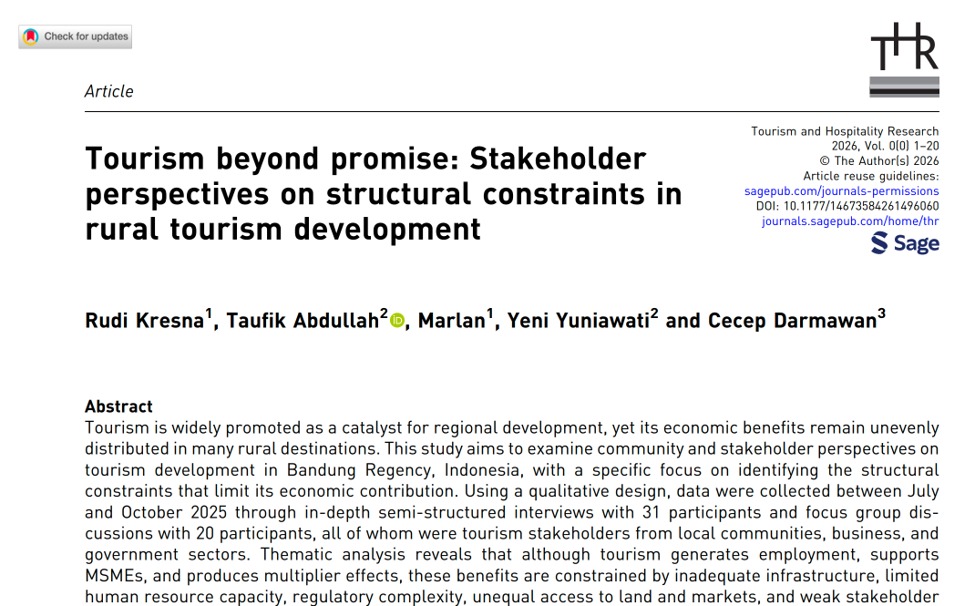
BANDUNG — The Tourism Marketing Management Study Program (MPP), Universitas Pendidikan Indonesia (UPI), continues to strengthen its academic contribution to tourism development through international scholarly publications. One such achievement is the article entitled “Tourism beyond promise: Stakeholder perspectives on structural constraints in rural tourism development,” published online in Tourism and Hospitality Research, a journal published by SAGE Publications.
The article examines structural challenges in rural tourism development in Bandung Regency, Indonesia, highlighting stakeholder perspectives on the opportunities, barriers, and distribution of tourism-related economic benefits among local communities.
This publication represents an academic contribution relevant to the university’s Key Performance Indicators (KPIs), particularly IKU 5 on Collaboration and Research Commercialization, while also supporting the global sustainable development agenda through the Sustainable Development Goals (SDGs).
Examining Structural Challenges in Rural Tourism Development
The study employed a qualitative approach, with data collected between July and October 2025. The data were obtained through semi-structured in-depth interviews with 31 participants and focus group discussions (FGDs) involving 20 participants from local communities, business operators, and government representatives.
The findings reveal that tourism has the potential to create employment opportunities, support micro, small, and medium-sized enterprises (MSMEs), and generate economic multiplier effects for local economies. However, realizing this potential remains challenging due to several structural barriers, including inadequate infrastructure, limited human resource capacity, regulatory complexity, unequal access to land and markets, and weak coordination among stakeholders.
These findings highlight that destination development requires more than attractive tourism products and increased visitor numbers. Strengthening community capacity, improving governance, expanding market access, and fostering cross-sector collaboration are also essential to ensure that tourism generates more inclusive economic benefits.
Contributing to IKU 5: Collaboration and Research Commercialization
IKU 5 is one of the university’s Key Performance Indicators concerning collaboration and research commercialization, including research outputs generated through collaboration between higher education institutions and external partners, such as other universities, industry partners, government institutions, civil society organizations, and other stakeholders.
In this context, research publications that address the actual needs and challenges of the tourism sector demonstrate the role of higher education institutions in generating knowledge that can inform decision-making and support policy development.
This study on the structural challenges of rural tourism development provides empirical findings that may serve as a reference for local governments, destination managers, tourism businesses, and communities in formulating development strategies that are more responsive to local conditions.
The achievement aligns with the objectives of IKU 5, which seeks to strengthen the relevance of academic outputs through partnerships and the utilization of research findings. The recognition of this publication as an IKU 5 output remains subject to UPI’s applicable criteria and supporting evidence of collaboration or research commercialization.
Supporting the Sustainable Development Goals (SDGs)
Beyond its relevance to university performance, the study is connected to several United Nations Sustainable Development Goals.
SDG 8 – Decent Work and Economic Growth. The study examines tourism’s potential to create employment, support MSMEs, and promote more inclusive local economic growth. These aspects align with efforts to encourage productive economic activities and strengthen community-based enterprises.
SDG 11 – Sustainable Cities and Communities. The research highlights the importance of destination governance, infrastructure, community participation, and stronger development linkages between rural areas and other regions. These aspects support efforts to build inclusive and sustainable communities.
SDG 17 – Partnerships for the Goals. The study emphasizes the importance of coordination and collaboration among stakeholders in addressing barriers to tourism development. Synergies among government institutions, academics, businesses, and local communities are essential to advancing sustainable development.
These connections demonstrate that tourism research can contribute not only to the advancement of academic knowledge and industry practices but also to local economic development, stronger communities, and cross-sector partnerships.
Article Information
- Title: Tourism beyond promise: Stakeholder perspectives on structural constraints in rural tourism development
- Journal: Tourism and Hospitality Research
- Publisher: SAGE Publications
- DOI: https://doi.org/10.1177/14673584261496060
Read the full article: https://journals.sagepub.com/doi/10.1177/14673584261496060
Author: Rijal Khaerani