Civic Education Study Program Master
Profile
The Master's degree program in Civics Education was
established on June 8, 2005, based on the Rector's Decree of UPI as a
State-Owned Legal Entity (BHMN) Number 3042/j33/PP.03.02/2005. The Civics
Master's program at UPI became the first of its kind in Indonesia. The
establishment of this program was based on the ideas and considerations of
senior faculty members since 2003, particularly initiated by Prof. Dr. Abdul
Azis Wahab, MA, who was the Director of UPI's Graduate School at the time. He
tasked Prof. Dr. Suwarma Al Muchtar, SH, M.Pd, the Dean of FPIPS, and Prof. Dr.
Sapriya, M.Ed, the Head of the Civics Department, with drafting the proposal
for the establishment of the Civics Master's Program.
Through a series of intensive meetings with senior faculty members of the
Civics Program, including Prof. Drs. Achmad Kosasih Djahiri, Prof. Muhammad
Nu’man Somantri, M.Sc.Ed, Prof. Dr. Achmad Sanusi, SH., MPH, Prof. Dr. Endang
Sumantri, M.Ed., Prof. Dr. Idrus Affandi, SH, Prof. Dr. Ranidar Darwis,
and several other faculty members, the proposal was drafted by the Head of the
Civics Department in collaboration with the Dean of FPIPS. The proposal was
then refined through a plenary meeting of the Faculty of Education's Board of
Professors and submitted to the UPI Academic Senate until it was approved and established
by the Rector of UPI in 2005 through Decree Number 3042/j33/PP.03.02/2005
Vision
The vision of the Master's Program in Civics Education can
be explained as follows:
"To become a pioneering and excellent study program in producing experts
in Civics Education who possess a spirit of nationalism, love for the homeland
(patriotism), and are imbued with the Pancasila ideology."
As an effort to facilitate the achievement of its vision, the Master's Program
in Civics Education has formulated its mission, which includes:
Mission
Objectives
- To produce patriotic and Pancasila Citizenship Education experts who are able to solve citizenship education problems through an inter- or multidisciplinary approach, characterised by the production of work that has the potential to be applied in solving these citizenship problems.
- Producing Civic Education experts who are committed to the implementation of Pancasila, the 1945 Constitution of the Republic of Indonesia, the Unitary State of the Republic of Indonesia, and Unity in Diversity and are able to analyse civic problems using an inter- and multidisciplinary approach.
- Produce accurate, tested, innovative models, methods, and/or theory development on civic education concerning academic, curricular, and sociocultural domains, which can be scientifically published in national (accredited) scientific journals and/or indexed international journals.
- Produce various forms of cooperation and networking in the context of organising and developing Master of Civic Education education that contributes to planning a research road map and/or research and development through an inter- and multidisciplinary approach.
- Meet the needs of the community in the field of work group leadership, management, training, upgrading, consultation, and evaluation of the implementation of programmes under their responsibility
Accreditation
The Master of Citizenship Education study program of the Indonesian Education University has so far implemented a quality assurance system that refers to the quality assurance system of PT in Indonesia in accordance with the Law of the Republic of Indonesia Number 12 of 2012 (Article 53) concerning the Quality Assurance System of Higher Education. The quality assurance system in the Master of Citizenship Education study program has 2 parts, namely; Internal Quality Assurance System and External Quality Assurance System.
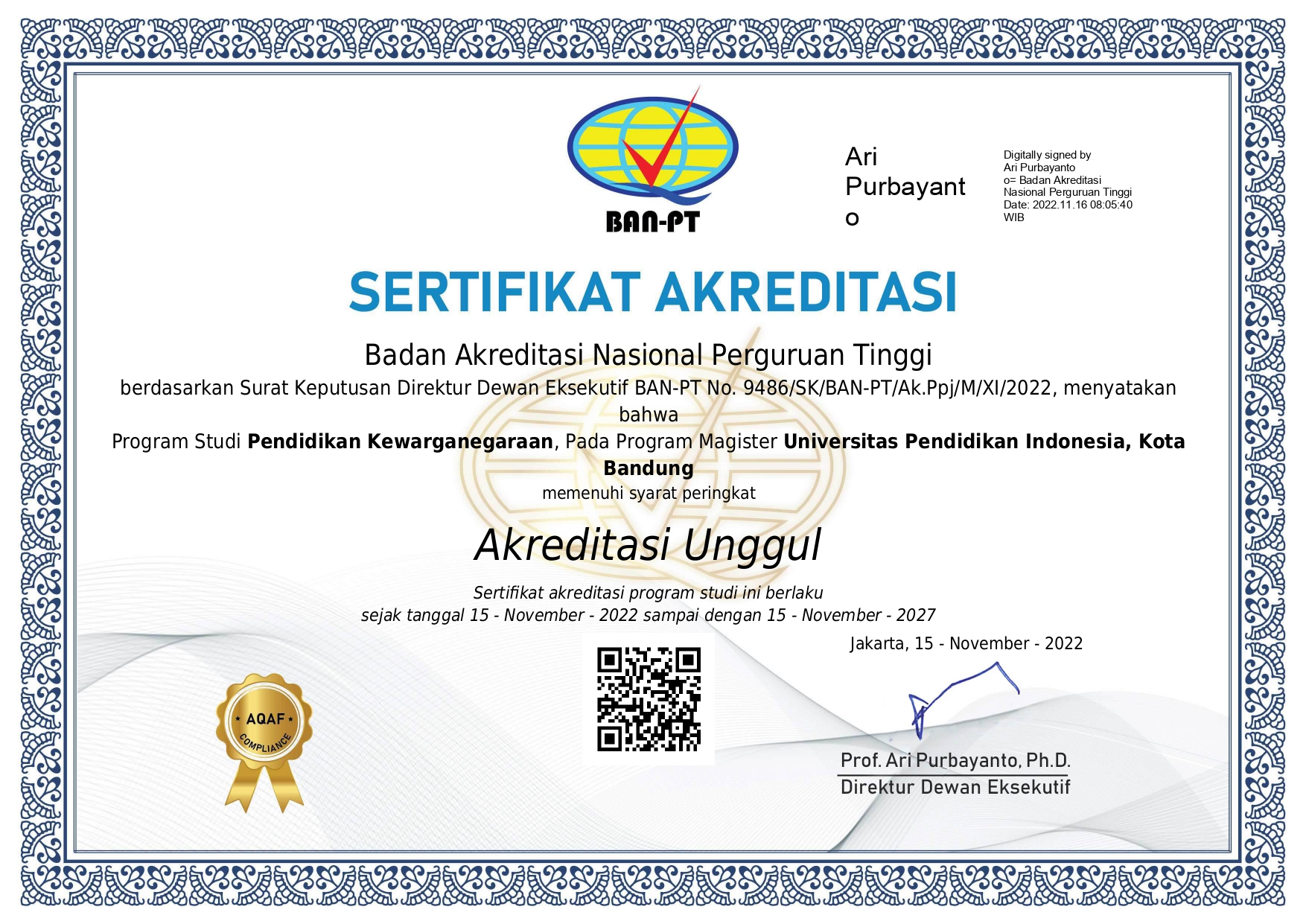
Since its establishment in 2005, the Civic Education Study Program at the Masters (S2) level at UPI has been accredited by BAN PT 3 times. The first accreditation was in 2011. BAN PT accredited and assigned a Grade A (379), very good, with Decree No. 011/BAN-PT/AK-IX/S2/VIII/2011, dated August 12, 2011. The second accreditation (reaccreditation) by BAN PT in 2016. The result of the accreditation assessment was a Grade A (380), very good with Decree Number 2016/No.2805/SK/BAN-PT/Akred/M/XI/2016, valid until June 2021. The third accreditation was based on the Decree of the Director of the Executive Board of BAN-PT No. 9486/SK/BAN-PT/Ak.Ppj/M/XI/2022, it was determined that the Civic Education Study Program received an Excellent Accreditation rating (Accreditation Certificate Attachment) This study program accreditation certificate is valid from November 15, 2022 to November 15, 2027.
Home Base Lectures
|
No |
Name and Title |
Position |
Highest degree from, year |
Research Interest |
Certificate of Competence
/ Profession |
Taught Modul |
Required teaching load |
Type |
|
1 |
2 |
3 |
4 |
5 |
6 |
7 |
8 |
9 |
|
1 |
Prof. Dr. Hj. Kokom
Komalasari, M.Pd. |
Guru Besar |
UPI, 2009 |
Living Value |
V |
Civics Learning Theories
and Models |
16 |
Permanent Lecturer |
|
2 |
Prof. Dr. Rahmat, M.Si. |
Guru Besar |
UPI, |
Civics Learning |
V |
Study of Theory and Application of Character Education |
16 |
Permanent Lecturer |
|
3 |
Dr. Iim Siti Masyitoh,
M.Si. |
Lektor Kepala |
UPI |
Civic education |
V |
Civics Theory, Values
Education and Character Education |
16 |
Permanent Lecturer |
|
4 |
Prof. Dr. Prayoga
Bestari, M.Si. |
Guru Besar |
UNPAD |
Public Policy |
V |
Independent Study |
16 |
Permanent Lecturer |
|
5 |
Dr. Sri Wahyuni Tanshzil,
M.Pd. |
Lektor |
UPI |
Civic Education Political Education |
V |
Philosophy of Law |
16 |
Permanent Lecturer |
Lectures



Research & Scientific Publication
Civic Education Study Program Master
The Master of Citizenship Education (PKn) Study Program of Universitas Pendidikan Indonesia (UPI) has a strong commitment to implementing quality assurance of research and scientific publications as an integral part of the Tri Dharma of Higher Education. Since its establishment on June 8, 2005, the study program, which has received three "A" (very good) and superior accreditations from BAN-PT, has consistently encouraged lecturers and students to be active in research activities that are relevant to contemporary citizenship and education issues. This effort aims to produce quality scientific works that not only contribute to the development of science, but also provide practical solutions to the problems of citizenship education in Indonesia.
Research and Publication Support Ecosystem
To support research and publication activities, the study program provides access to various research funding schemes, both internal and external. Internal funding can be accessed through the UPI grant portal at https://litabmas.upi.edu/ , while for external funding, lecturers can participate in the Ministry of Education's research grant program through the platform https://simlitabmas.kemdikbud.go.id/ . The university applies a multi-level approach in developing lecturers' research competencies, where initiatives can start from the study program level to the university, creating an ecosystem that supports sustainable professional growth. The study program also facilitates the publication of research results in national and international reputable journals, with a target of increasing student participation in lecturer research to 60% of the total student body
|
No. |
Jenis Publikasi |
Jumlah Judul |
Jumlah |
||
|
TS-2 |
TS-1 |
TS |
|||
|
1 |
2 |
3 |
4 |
5 |
6 |
|
1 |
Jurnal
penelitian tidak terakreditasi |
18 |
18 |
0 |
36 |
|
2 |
Jurnal
penelitian nasional terakreditasi |
10 |
10 |
10 |
30 |
|
3 |
Jurnal
penelitian internasional |
5 |
5 |
5 |
15 |
|
4 |
Jurnal
penelitian internasional bereputasi |
5 |
5 |
5 |
15 |
|
5 |
Seminar
wilayah/lokal/perguruan tinggi |
0 |
|||
|
6 |
Seminar
nasional |
13 |
15 |
15 |
43 |
|
7 |
Seminar
internasional |
16 |
16 |
19 |
51 |
|
8 |
Tulisan
di media massa wilayah |
10 |
10 |
10 |
30 |
|
9 |
Tulisan
di media massa nasional |
45 |
45 |
45 |
135 |
|
10 |
Tulisan
di media massa internasional |
0 |
0 |
0 |
0 |
|
Jumlah |
122 |
124 |
109 |
355 |
|
Curriculum
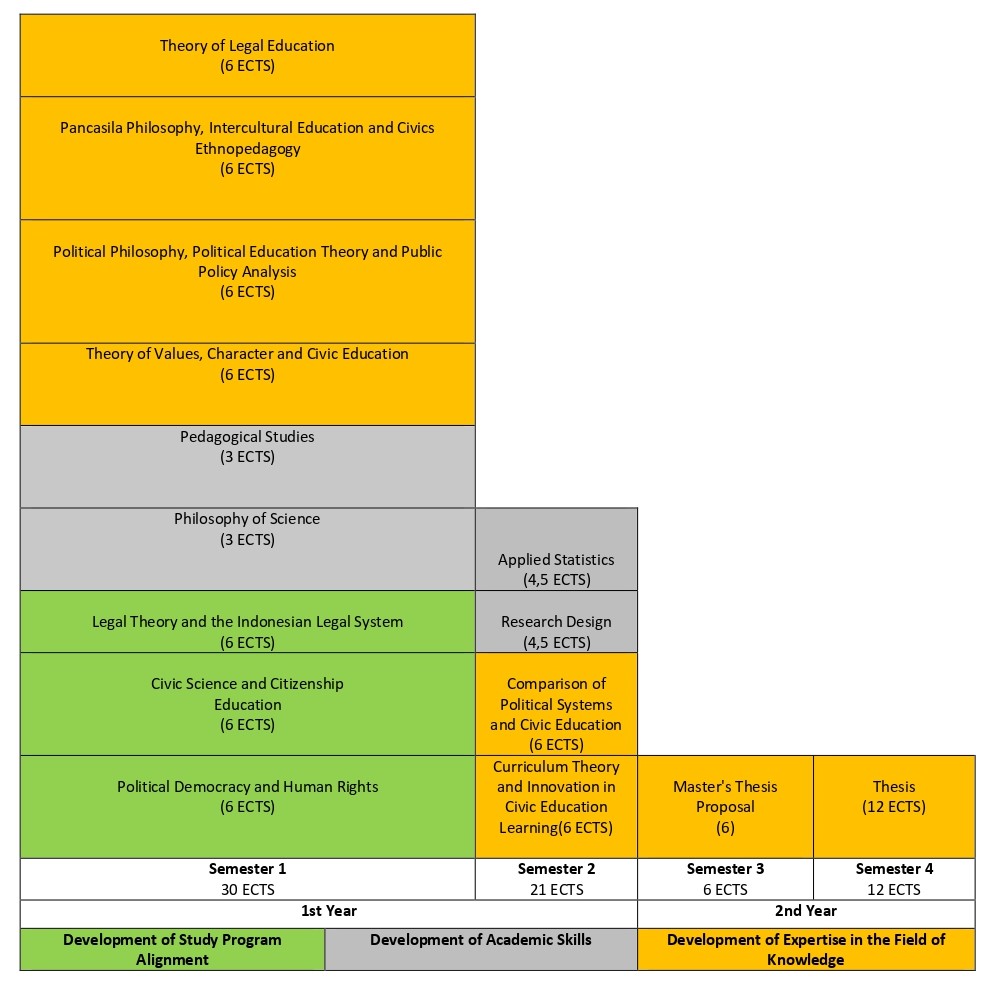
The development of the curriculum for each study program at the Indonesian Education University is based on the applicable Laws and Regulations. At the Masters level, the curriculum is designed to be completed in 3 to 4 semesters. In each semester, academic activities consist of 16 sessions, including 12-14 lecture meetings and 2 exams.
In the Masters Program in Citizenship Education, the total study load that must be taken for regular linear students is 50 credits (75 ECTS), while for regular non-linear students it is 62 credits (93 ECTS), with the addition of matriculation courses at the beginning of the semester, namely the following courses:
- Democracy and Human Rights (4 credits / 6 ECTS),
- Citizenship and Citizenship Education (4 credits / 6 ECTS), and
- Legal Theory and Indonesian Legal System (4 credits / 6 ECTS).
The division of credits at the Masters level is as follows: semester I – 20 credits (30 ECTS), semester II – 14 credits (21 ECTS), semester III – 4 credits (6 ECTS), and semester IV – 8 credits (12 ECTS. Meanwhile, based on the National Standards for Higher Education, 1 credit is equivalent to 170 minutes × 16 weeks = 2,720 minutes = 45.3 hours per semester. This value is converted to the ECTS standard as follows: 45.3 hours ÷ 30 hours = 1.5 ECTS. The curriculum of the Civics Education (PKn) Masters Program at the Indonesian Education University (UPI) is designed and compiled with a focus on developing civic literacy through the integration of legal, political, learning and civic education sciences based on the ethical and academic principles of Pancasila. The curriculum of the master's program in education prioritizes an inter-multidisciplinary approach as the main characteristic of the learning process. This approach not only equips students with critical theories on citizenship, but also emphasizes pedagogical innovation, applied research, and community-based social advocacy.
Facilities
Regarding the utilization of resources to support academic activities in the UPI Civic Education Masters program, it always utilizes the facilities provided by the University and Faculty. Until now, the Civic Education Masters Program has various supporting facilities as a means of learning in accordance with the standards of facilities and infrastructure stated in the Quality Policy of the Indonesian Education University. The number, type, and specifications of facilities are determined based on the characteristics of the learning methods and forms, which can guarantee the implementation of a good learning process. In general, the infrastructure provided by UPI includes learning facilities such as land, faculty buildings and other administrations, libraries, educational museums, training centers, laboratories, information and technology centers, art rooms, and dormitories. In addition, UPI must provide public facilities such as roads, water, electricity, wifi networks, parking, communication networks, polyclinics, green open spaces, canteens, places of worship, mini markets, bookstores, ATM centers and business galleries including campus security systems. (Attachment of documentation of facilities and infrastructure.
The study rooms utilized by the UPI Civics Masters program have met the building standards at UPI which have met the requirements for safety, health, comfort, and security. In addition, the facilities and infrastructure provided can be accessed by people with disabilities, equipped with Braille labeling, ramps for wheelchair users, guiding blocks on pedestrians, and floor plans and toilets for wheelchair users. (Attachment of documentation of infrastructure facilities for people with disabilities).
The facilities and infrastructure at FPIPS used by the Civics Masters program are very adequate, both in terms of quantity and specifications in order to ensure the implementation of academic and organizational activities. Communication channels are available in each room including lecturer lockers to be able to connect between rooms. In addition, there are also information tools placed in the information center room and then distributed to each room to facilitate the dissemination of information to the entire academic community. The availability of electricity and its channels is very large and connected to various existing rooms according to their designation.
To facilitate the academic community in accessing information via the internet, including for lecturers and students of the Civic Education Masters program, the Faculty has created a network that is connected to each room. In addition, it is also enriched by providing a hotspot network on each floor of the FPIPS building. Each room is equipped with chairs, tables, and furniture that are in accordance with their respective uses. Especially for the laboratory, it is equipped with a smartboard as multimedia in the learning process. The condition of the learning facilities in the Civic Education Masters program is currently quite ideal, especially regarding learning media, such as LCD Projectors, practical equipment, almost all lecture rooms are equipped with air conditioning and LCD Projectors. Thus, the lecture process runs well. Availability of UPI and FPIPS educational infrastructure used by FPIPS study programs. Budget support is very important in ensuring the achievement of study program learning outcomes, as well as supporting the achievements and performance of lecturers and students. Currently, FPIPS manages funds with a revenue ceiling of IDR 15,399,462,350 and an expenditure ceiling of IDR. 15,366,962,350,-. The funds are used for activities related to student affairs, education, research, community service, publications and FPIPS investments (Table 2.6.1). The largest proportion is in student and research funds. This is an effort to support and improve performance achievements in the fields of education and research, in accordance with UPI's vision and mission.
UPI Facilities: https://www.upi.edu/pendidikan/fasilitas
UPI Library: http://perpustakaan.upi.edu/
SELF ASSESMENT REPORT ACQUIN
The Self-Assessment Report (SAR) ACQUIN for the Master Program in Pancasila and Civic Education (PPKn) at Universitas Pendidikan Indonesia (UPI) provides a comprehensive evaluation of the program's quality assurance, curriculum, and accreditation processes. It outlines the program's structure, which includes undergraduate, master's, and doctoral levels, and highlights its accreditation achievements, such as AUN-QA international accreditation and BAN-PT national accreditation (Grade A). The report details the program's student-centered learning approach, integration of technology, and alignment with national and international standards, including the Indonesian National Qualifications Framework (KKNI) and Outcome-Based Education (OBE). It also covers faculty qualifications, student admission processes, learning resources, and stakeholder involvement in curriculum development. The document emphasizes UPI's commitment to producing graduates who uphold democratic values, critical thinking, and global competitiveness, supported by robust internal and external quality assurance mechanisms. The full report is accessible via the provided links.
MODULE HANDBOOK
This Module Handbook is an essential guide for the Pancasila and Citizenship Education (PPKn) Masters Program, which comprehensively details the curriculum, syllabus of each course, learning outcomes, teaching methods, and program assessment system. The aim is to ensure quality, transparency, and consistency in the implementation of postgraduate education, to be the main reference for students to understand their study path, and for lecturers in planning and implementing lectures in line with the program's vision and mission and the established academic standards.
SUMMARY OF ANNEX
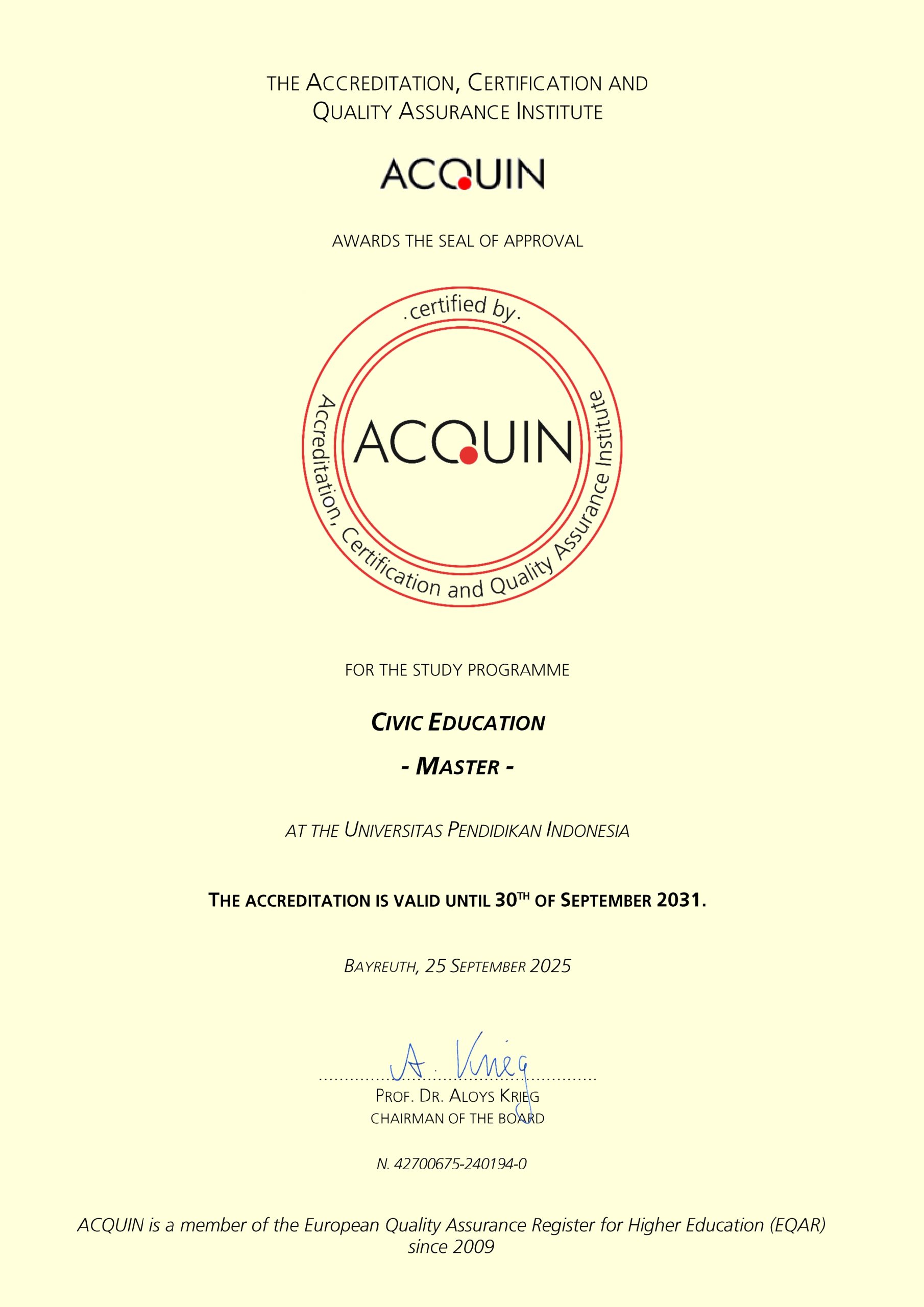
As part of the external quality assurance system in Indonesia, all study programs in this cluster have undergone national accreditation processes conducted by official accreditation bodies, namely the National Accreditation Board for Higher Education (BAN-PT) and Independent Accreditation Institutions (LAM)
LIST OF ANNEX CLUSTER SOCIAL 2
- SUMMARY OF ANNEX 0: National Recognition Documents
- SUMMARY OF ANNEX 1: QA Handbook
- SUMMARY OF ANNEX 2: Module Evaluation Guideline
- SUMMARY OF ANNEX 3: Study and Examination Regulations
- SUMMARY OF ANNEX 4: Complaints Policy
- SUMMARY OF ANNEX 5: Admission Regulation
- SUMMARY OF ANNEX 6: Learning Agreement Regulation
- SUMMARY OF ANNEX 7: Diploma Supplement
- SUMMARY OF ANNEX 8: CVs of Full Professors and Academic Lecturers
- SUMMARY OF ANNEX 9: Staff Recruitment or Hiring Policy
- SUMMARY OF ANNEX 10: Teaching Load and Ratio
- SUMMARY OF ANNEX 11: Overview of Labs and Equipment
- SUMMARY OF ANNEX 12: Overview of Library Resources
- SUMMARY OF ANNEX 13: Career Paths for the Graduates
- SUMMARY OF ANNEX 14: Data Collection Policy and Progression Rates
- SUMMARY OF ANNEX 15: Evaluation Results of Students and Alumni
- SUMMARY OF ANNEX 16: Advertising Material
- SUMMARY OF ANNEX 17: Blended Learning or Distance Learning Achievements
- SUMMARY OF ANNEX 18: Graduation Certification
- SUMMARY OF ANNEX 19: Industry Partners/User
- SUMMARY OF ANNEX 20: International Office Regulations
- SUMMARY OF ANNEX 21: Module Recognition Regulations
- SUMMARY OF ANNEX 22: On-going Monitoring and Periodic Review of Programs
- SUMMARY OF ANNEX 23: Overview of IT-Infrastructure
- SUMMARY OF ANNEX 24: Partner Universities
- SUMMARY OF ANNEX 25: Research Activities
- SUMMARY OF ANNEX 26: Study Schedules
- SUMMARY OF ANNEX 27: Thesis or Abstract Examples for All Programs