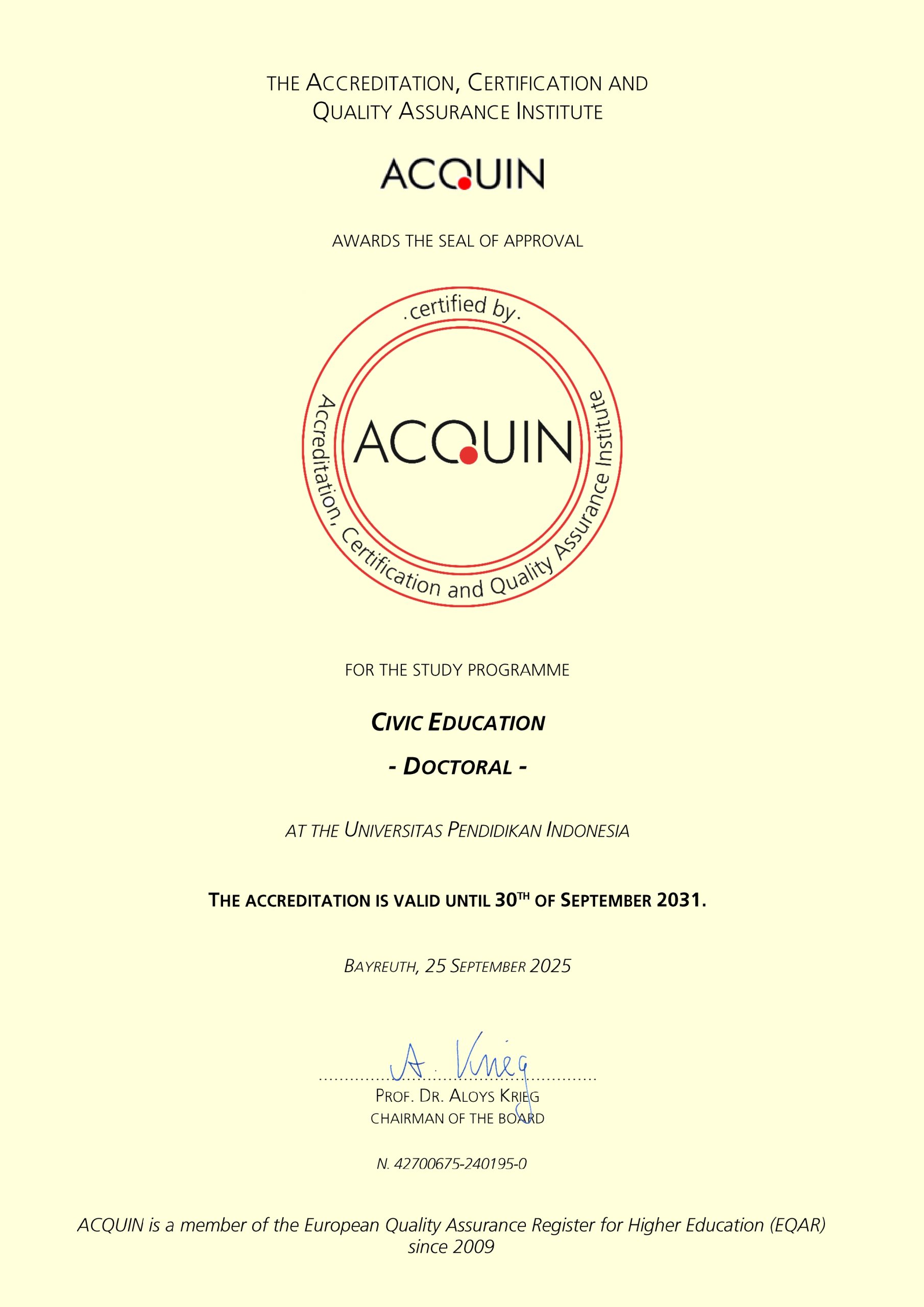
Civic Education Study Program Doctoral
History
The Civic Education Study Program at the doctoral level (S3) was established on August 15, 2008 based on the Decree of the Rector of UPI State-Owned Legal Entity (BHMN) Number 4879/H40/PP/2008. UPI's Civic Education study program at doctoral level (S3) is the first civic education study program in Indonesia. The establishment of this study program was based on the thoughts and considerations of senior lecturers in 2007 and 2008, especially the initiation of Prof. Drs. Achmad Kosasih Djahiri, Prof. HM Nu'man Somantri, M.Sc.Ed., Prof. Dr. H Endang Sumantri, M.Ed., Prof. Dr. Abdul Azis Wahab, MA, and Prof. Dr. H Dasim Budimansyah, S.Pd., M.Si. The proposal for the establishment of the Civics Education Doctoral Study Program (S3) which had previously been approved through a meeting of the Lecturer Council of the Civics Education Department FPIPS UPI and approval from the Academic Senate received the determination of the UPI Rector in 2008 through Decree Number: 4879/H40/PP/2008.
In 2008, the first Doctoral level Civic Education Study Program (S3) in Indonesia was established, led by Prof. Dr. H. Dasim Budimansyah, S.Pd., M.Si. until 2012. From 2012 to 2019 the leader of the Doctoral Level Civic Education Study Program was held by Prof. Dr. H. Sapriya, M.Ed. The name (nomenclature) of the Doctoral level study program at UPI since its establishment until now has not changed, namely Civic Education.
Vision
The Civic Education Study Program at the doctoral level (S3) has a vision “to become a pioneer and superior study program in producing Civic Education experts who have a sense of nationality, love for the country (patriotic), and Pancasilais.”
Mission
The achievement of the vision is carried out with steps as its mission, namely:
- Organizing Doctoral education in Civic Education which is oriented towards mastering knowledge of civic science, politics, law, economics, statehood, history of the nation's struggle, values, morals, culture and philosophy of Pancasila, and research in line with the development of national and global social and political life.
- Conduct a study of the pillars of nationalism which include Pancasila, the 1945 Constitution of the Republic of Indonesia (UUD NRI 1945), the Unitary State of the Republic of Indonesia (NKRI), and Unity in Diversity (Bhinneka Tunggal Ika) with its problems using inter-, multi- and transdisciplinary approaches.
- Conduct studies of Civic Education as an integrated discipline, synthetic discipline, or disciplinary education and its application for the development of expertise in the field of Civic Education.
- Building cooperation and networks in the context of organizing and developing Doctoral education in Civic Education in order to play a role and develop as experts or academics who are able to solve complex civic education problems through inter-, multi- and transdisciplinary approaches.
- Organizing training, upgrading, and consulting services on Civic Education programs for the community.
Objectives
The objectives of the study programme include:
- Producing patriotic and Pancasila Civic Education experts who are able to solve complex civic education problems through inter-, multi-, and transdisciplinary approaches, characterized by the production of works that have the potential to be applied in solving these civic problems.
- Producing Civic Education experts who are committed to the implementation of Pancasila, the 1945 Constitution of the Republic of Indonesia, the Unitary State of the Republic of Indonesia, and Unity in Diversity and are able to analyze civic problems using inter-, multi-, and transdisciplinary approaches.
- Produce accurate, tested, innovative models, methods, and/or theory development on civic education concerning academic, curricular, and sociocultural domains, which can be scientifically published in national (accredited) scientific journals and/or indexed international journals.
- Produce various forms of cooperation and networking in the context of organizing and developing Civic Education Doctoral education that contributes to planning a research road map and/or research and development through an inter-, multi-, and transdisciplinary approach.
- Meet the needs of the community in the areas of working group leadership, management, training, upgrading, consultation, and evaluation of the implementation of programs under his/her responsibility.
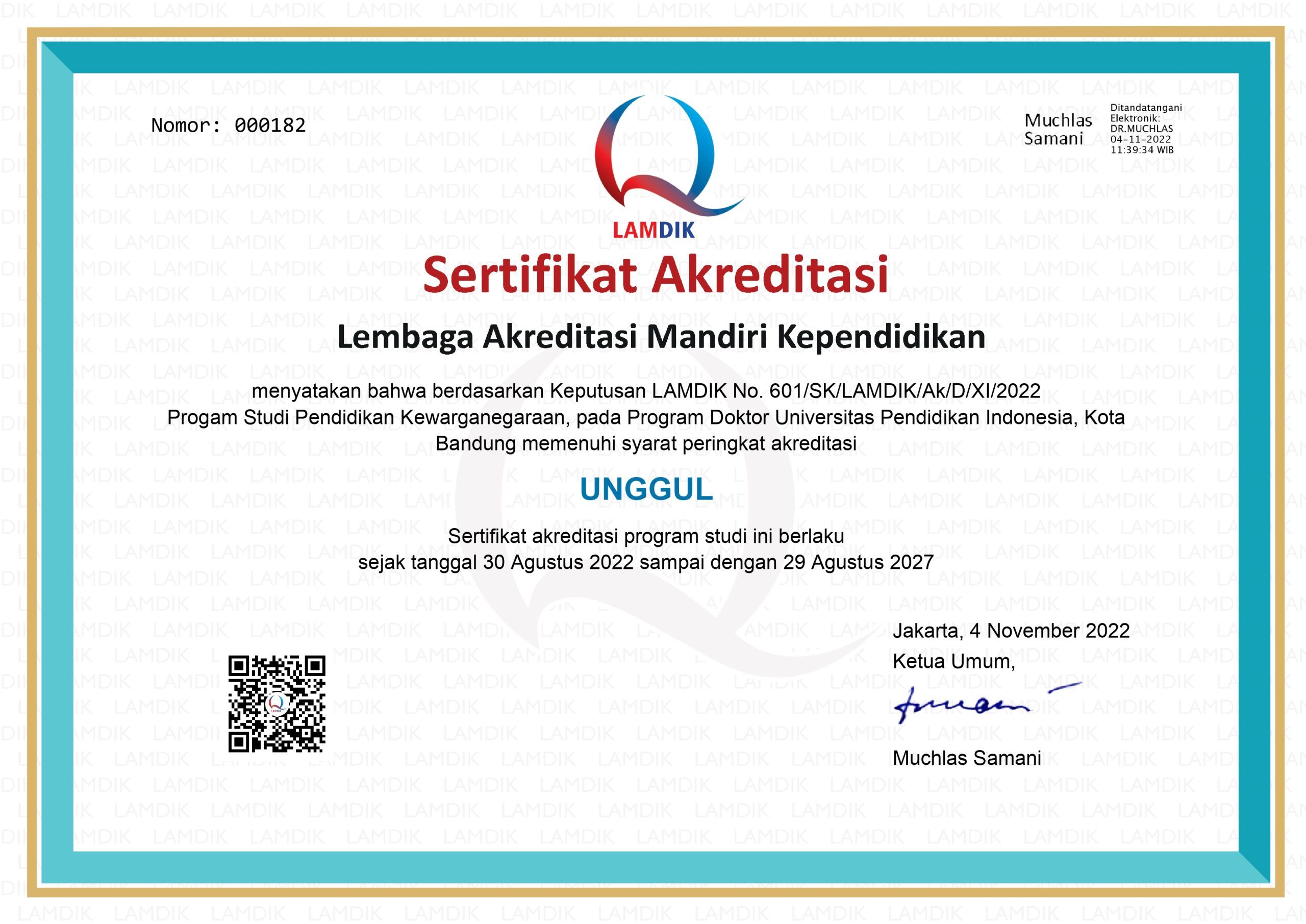
Since
the establishment of this Civic Education study program, it has been accredited
by BAN PT twice and LAMDIK once. The first accreditation was on July 27, 2012
with the acquisition of a very good A (362) as stated in Decree Number
009/BAN-PT/Ak-XI/S3/VII/2012 which is valid until July 27, 2017.
The
second accreditation based on BAN-PT decision No.
3103/SK/BAN-PT/Akred/D/VIII/2017 states that the civic education study program
at the UPI doctoral program (S3) is accredited with an A rating valid from
August 29, 2017 to August 29, 2022.
The
third accreditation was obtained from the Education Self Accreditation
Institute (LAMDIK) in 2022 with Decree Number 601/SK/LAMDIK/Ak/D/XI/2022
obtaining a superior accreditation rating, which is valid until 2027.
Table 1. Accreditation Achievement
|
Civics
Study Program |
YEAR |
||
|
2012 |
2017 |
2022 |
|
|
Assessment
Results |
Very
good |
Very
good |
Superior |
|
Link |
Certificate
2012-2017 |
||
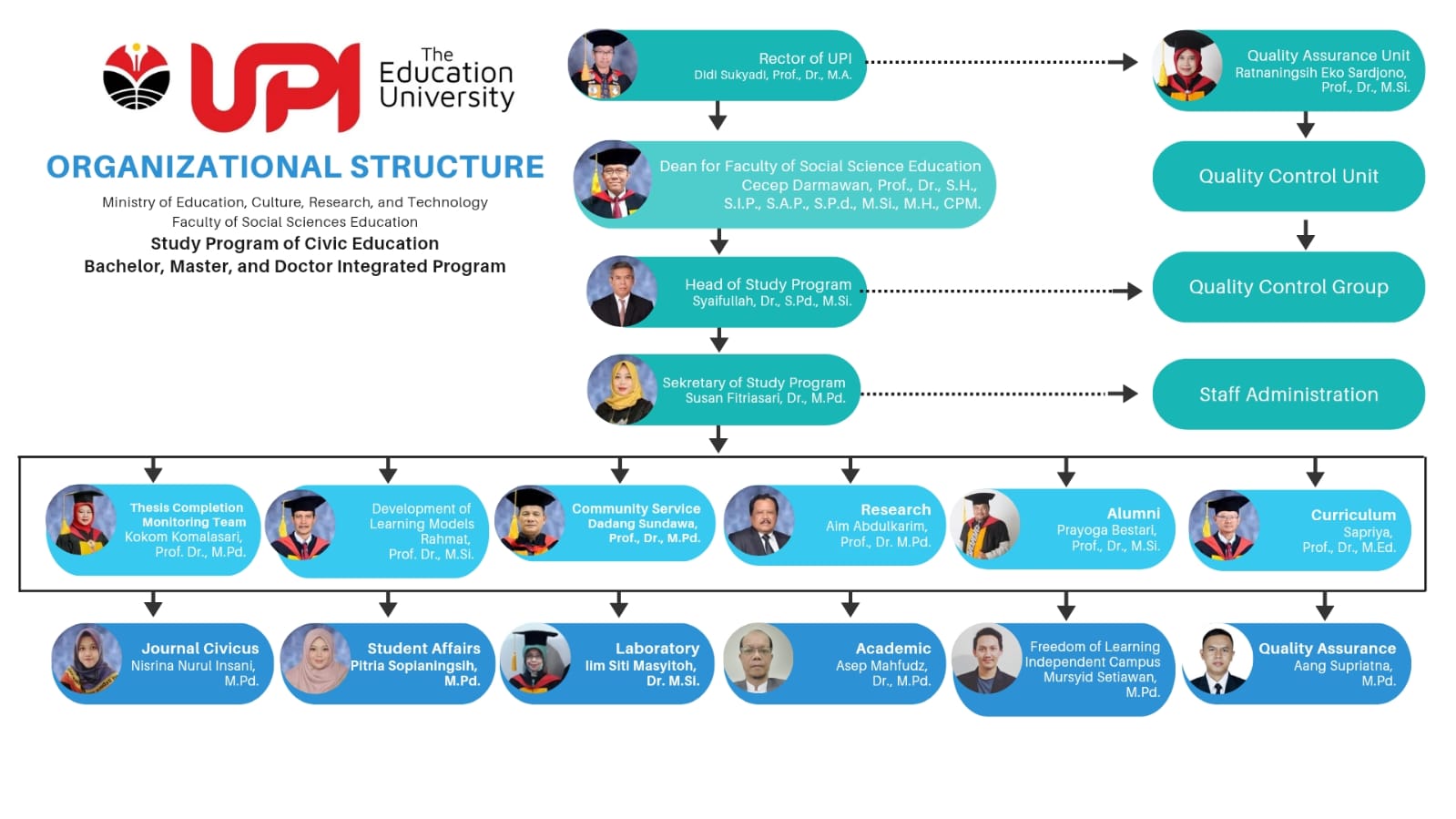
Homebase Lecturer of Doctor of Civic Education Study Program
|
No |
Name and Title |
Position |
Highest degree from |
Research Interest |
Certificate of Competence / Profession |
Taught Modul |
Required teaching load |
Type |
CV |
|
1 |
2 |
3 |
4 |
5 |
6 |
7 |
8 |
9 |
10 |
|
1 |
Prof. Dr. H. Aim Abdulkarim, M.Pd. |
Professor |
UPI, 2006 |
Learning |
V |
Fundamentals of Political Science |
16 |
Permanent Lecturer |
|
|
2 |
Prof. Dr. H. Dasim Budimansyah, M.Si. |
Professor |
UNPAD |
Sociology of Citizenship |
V |
Comparison Civic Education |
16 |
Permanent Lecturer |
|
|
3 |
Prof. Dr. H. Karim Suryadi, M.Si. |
Professor |
UNPAD |
Political Communication |
V |
Intercultural Education |
16 |
Permanent Lecturer |
|
|
4 |
Dr. Syaifullah, M.Si. |
Lector |
UPI |
Civic Education |
V |
Community Civics |
16 |
Permanent Lecturer |
|
|
5. |
Dr. Leni Anggraeni, S.Pd., M.Pd. |
Head Lector |
UPI |
Community Empowerment |
V |
International Political Life (World Politic) |
16 |
Permanent Lecturer |
Prof. Dr. Aim Abdul Karim, M.Pd.
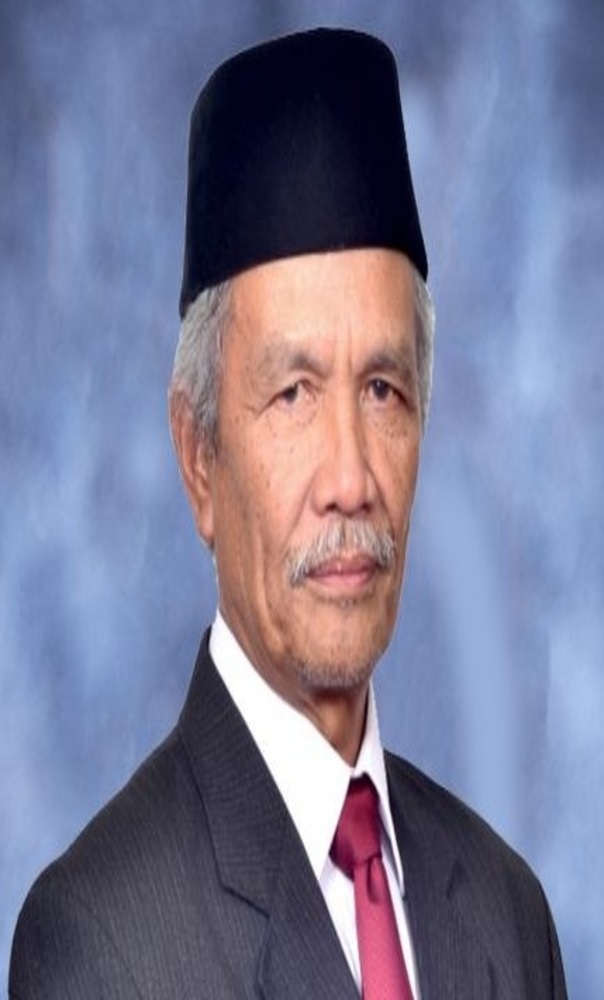
Prof. Dr. Endang Danial, AR., M.Pd., M.Si.
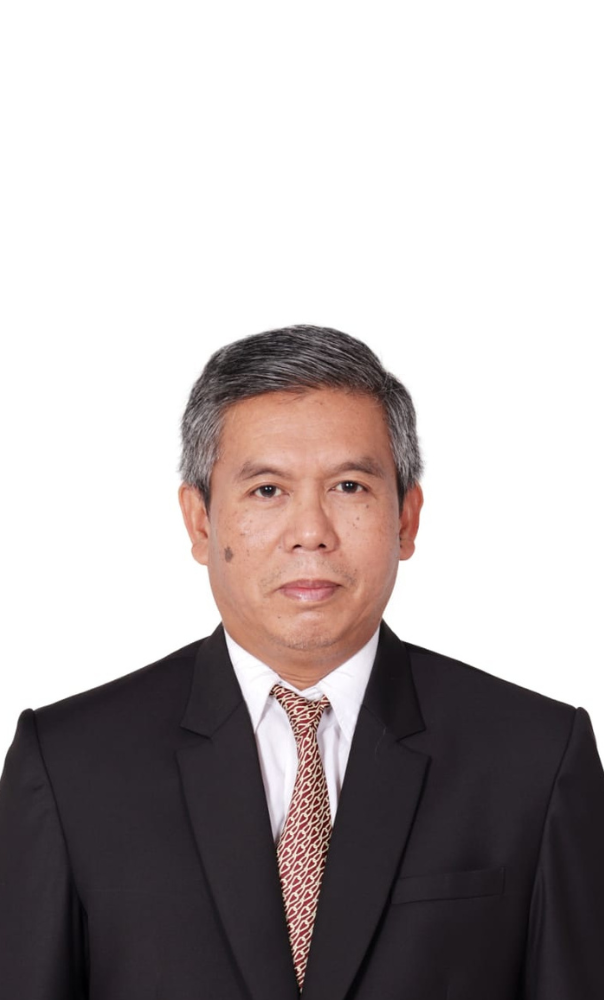
Dr. Syaifullah, M.Si.
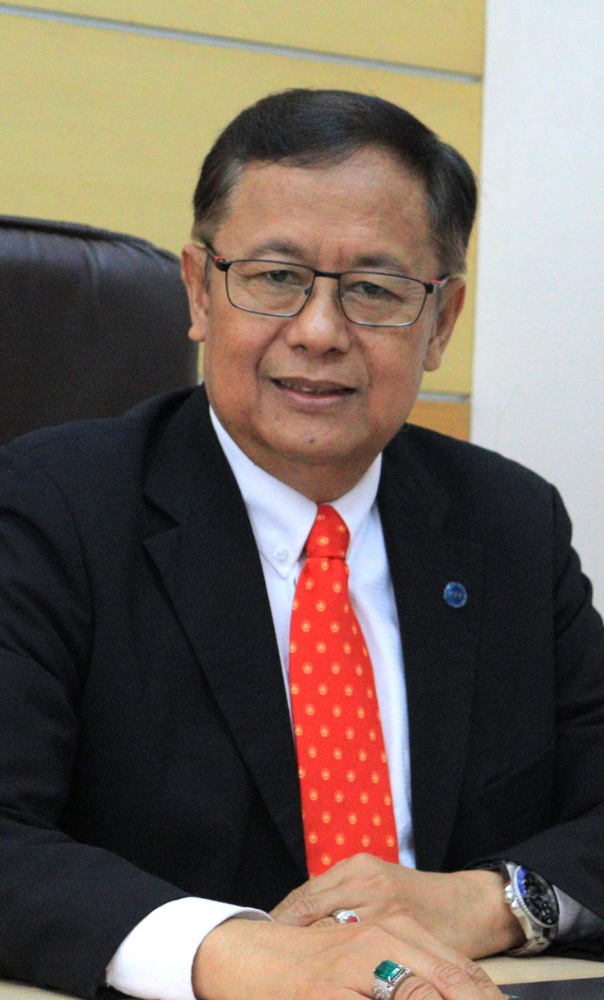
Prof. Dr. Dasim Budimansyah, M.Si.
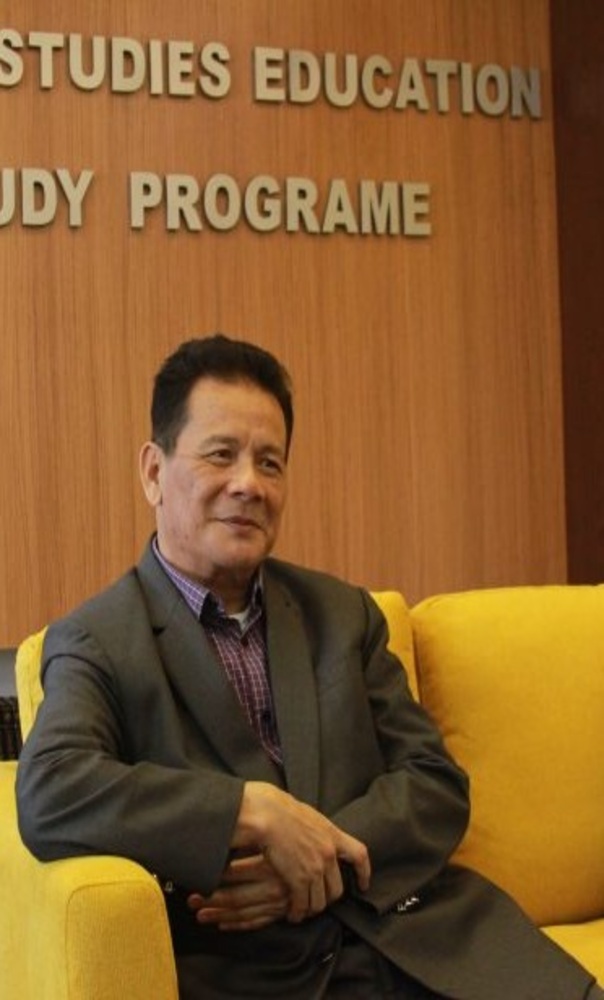
Prof. Dr. Dadang Sundawa, M.Pd.
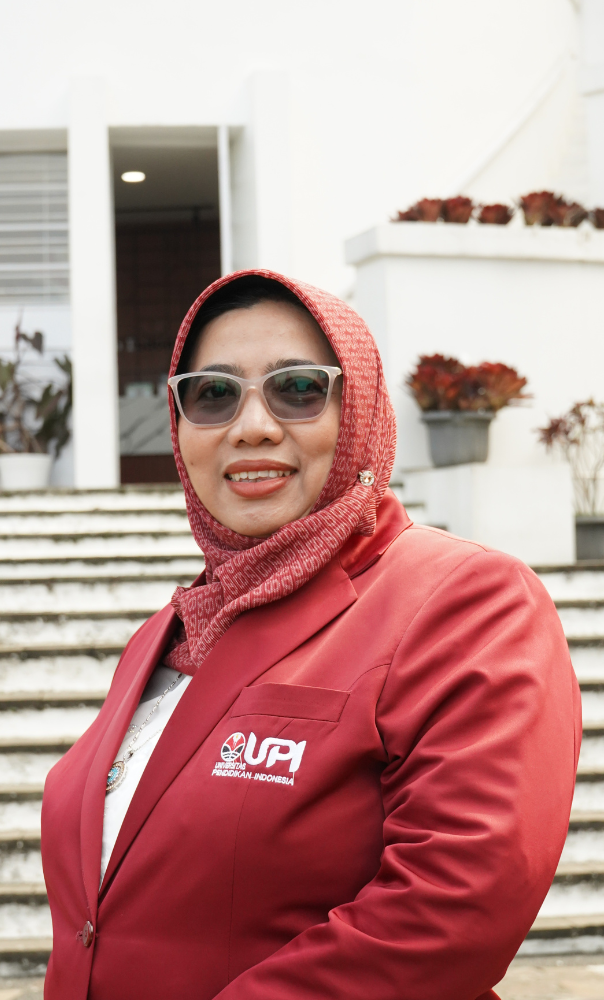
Dr. Leni Anggraeni, M.Pd.
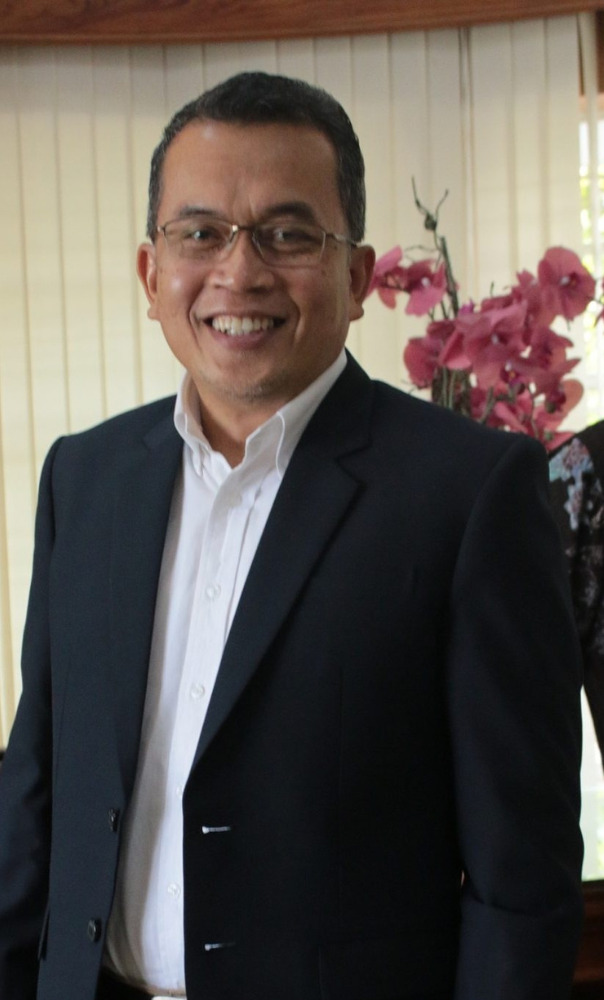
Prof. Dr. Karim Suryadi, M.Si.

Prof. Dr. Cecep Darmawan, S.H., S.I.P., S.A.P., S.Pd., M.Si., M.H.
Research & Scientific Publication
To support research and publication activities at doctoral level, the study program provides comprehensive access to various funding schemes. Doctoral students can take advantage of internal funding available through the university grants portal, providing flexibility for the development of initial research proposals. In addition, we actively encourage the utilization of competitive external funding, including research grant programs from the Ministry of Education and Culture through the https://simlitabmas.kemdikbud.go.id/ platform, as well as funding schemes from national and international research institutions relevant to the field of study.
Research and Publication Doctoral Level (Dissertation)
Original and Substantial
Contribution: Dissertation research is the culmination of academic education,
expected to produce original, significant, and substantive contributions to the
body of knowledge in the field.
Research Independence: Doctoral
students are required to demonstrate independence and leadership in their
research, while remaining under the supervision of their advisor.
Mastery of Advanced Methodology:
The use of innovative and complex methodologies is the standard.
Reputable International
Publications: Publications in reputable international journals are often a
prerequisite for graduation, demonstrating global recognition of their research
contributions.
Research Network Development:
Doctoral students are expected to build networks with other researchers and
actively participate in the international scientific community.
Examples of Dissertations by Doctoral Students in Civic Education: Link
Synergy Between Lecturer and Student Research
The relationship between faculty
and student research is symbiotic. Faculty provide guidance, expertise, and
resources, while students contribute energy, fresh ideas, and new perspectives.
Research-Based Learning: Students
learn directly from faculty members how to conduct high-quality research, from
formulating ideas to publication.
Research Teams: Many faculty
research projects involve students as part of the research team, providing
invaluable practical experience for students.
Researcher Regeneration: Through
student research, institutions prepare future researchers and academics with
strong research skills.
Increased Productivity: Student
involvement in faculty research can increase the volume and speed of overall
research output.
Appendix Research and Publications by Lecturers and Students: Link
The
development and structure of the Civics Doctoral programme curriculum is
philosophically based on the basic values of Pancasila which aims to shape
students to be able to conduct cutting-edge research, develop new theories and
practices, and make significant contributions in the field of Civic Education
both nationally, regionally and internationally. Because in its implementation,
the curriculum structure of the Civics Doctoral programme pays attention to or
is student-centred which focuses on independent and lifelong learning as a
manifestation of humanistic philosophy and in accordance with the basic values
of Pancasila, namely the value of divinity, the value of humanity, the value of
unity, the value of democracy, and the value of justice, to produce graduates
who are able to: conduct innovative research and develop new theories and
practices, and make significant contributions in the field of Civic Education
both nationally, regionally and internationally original knowledge in the
context of Civic Education; develop new theories and practices in the field of
Civic Education; apply inter, multi, and transdisciplinary approaches in
solving problems; manage and lead research and development that benefits
society through citizenship projects; and receive national and international
recognition for research and scientific contributions through scientific
publications related to Civic Education.
This Civic
Education Doctoral Program Module Handbook presents a comprehensive and
structured curriculum framework, designed to produce graduates who have
in-depth expertise in the theory and practice of civic education. This
curriculum is designed to equip students with high scientific competence,
qualified research skills, and strong philosophical understanding, in line with
the vision of the study program to become a center of excellence in the study
and development of civic education. The handbook module of the Civic Education
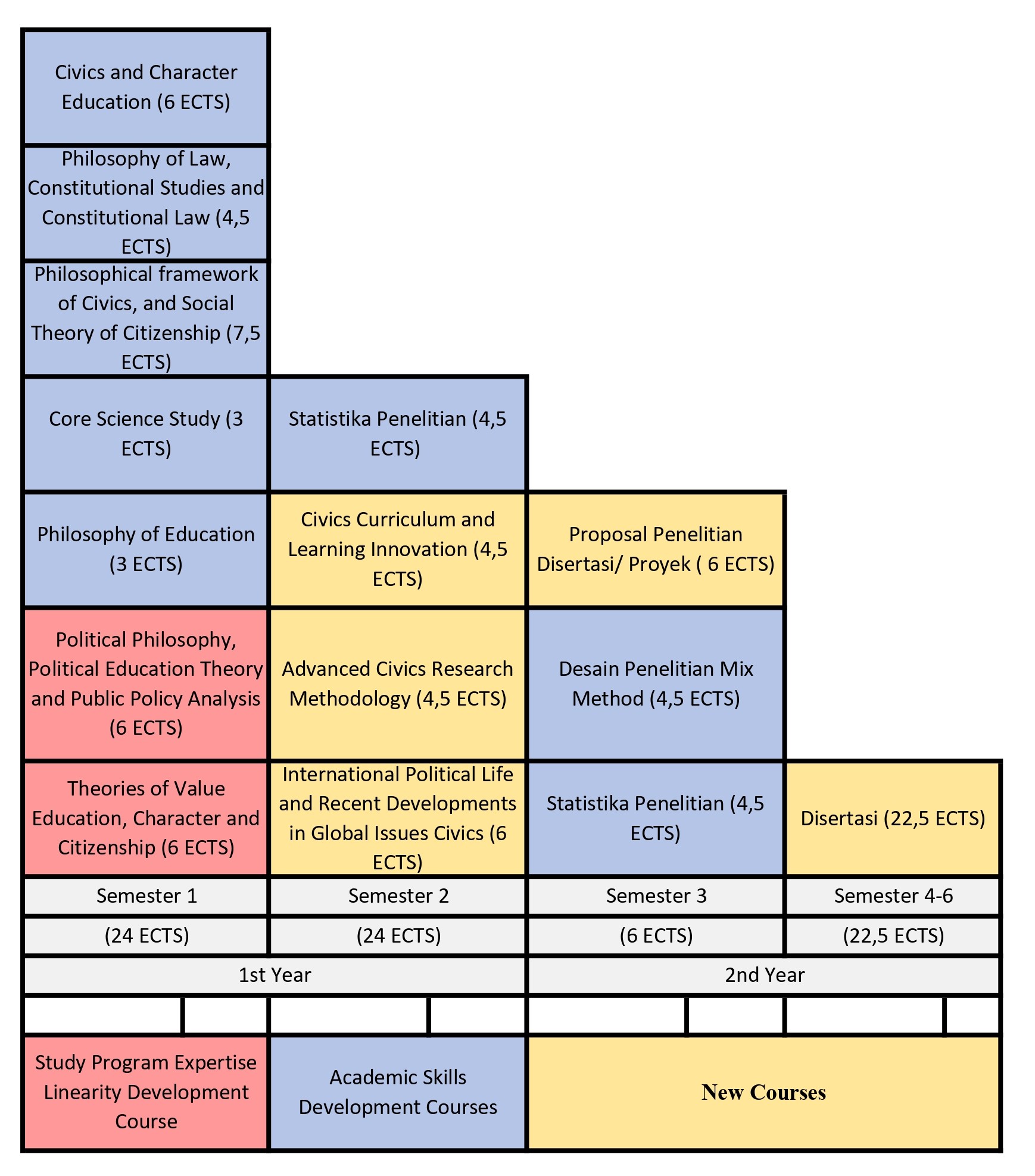
doctoral program outlines 14 courses designed for 6 semesters (three academic
years). With each semester offering 6 ECTS to 24 ECTS, and carrying a
total academic load of 76.5 ECTS.
This Module Handbook divides the curriculum into semesters with a clear focus: Semester 1 (8 courses): Focuses on the theoretical and philosophical foundations of Civic Education. Courses in this semester are of the Skill Development Field of Science type, indicating an emphasis on substantive skill development. Semester 2 (4 Courses): Continues the deepening of methodology and contemporary issues in Civics Education. The courses in this semester are also of the Skill Development Field of Science type, strengthening research and innovation competencies. Semester 3 (1 Course): Dedicated to dissertation preparation. Professional Field of Science, emphasizing students' ability to develop quality doctoral research proposals. Semester 4-6: The entire focus is allocated to the completion of the Dissertation (KN713). The dissertation is the culmination of the academic process that demonstrates the student's ability to conduct independent research, contribute to scientific knowledge, and produce original written work.
The full module handbook is available at the following link: Handbook Module PKn S3
Curriculum information for the Civic Education Doctoral Program can be accessed in full through the following website: https://kurikulum.upi.edu/struktur/prodi/P177
Facilities and Infrastructure
Various learning facilities and
student support services have been provided by the University and Faculty, such
as libraries, sports centers, and open spaces. The Civic Education Doctoral
Program also has several learning facilities and student activities. As part of
the Faculty of Social Science Education (FPIPS), the Civic Education Doctoral
Program shares a lecture hall located within the FPIPS building. The faculty
applies resource sharing for both lecture rooms and other spaces to support
learning, meetings, and other student activities.
For offline learning activities,
the Civic Education Doctoral program is equipped with two lecture rooms located
on the 4th floor (4.1 and 4.10), one laboratory room, a civic corner on the 2nd
floor, and a lecturer workspace consisting of 8 rooms spread across the 2nd,
3rd, and 4th floors of the FPIPS UPI building.
Lecture rooms for students of the
Civic Education Doctoral Program are equipped with complete and good
facilities, such as: lecture tables, blackboards, air conditioners (AC), Liquid
Crystal Display (LCD) projectors, speakers, wireless projectors, and Wireless
Fidelity (Wi-Fi). Chairs and tables are movable, allowing for flexible
classroom activities according to the creativity and learning objectives of
each session.
In addition, students of the Civic
Education Doctoral Program can access the smart classroom located in the FPIPS
building for hybrid classes or academic agendas, such as visiting professors or
activities that require teleconferencing. This room is equipped with a smart
TV, smart board, and other supporting facilities such as a sound system and a
working camera recorder.
The Civic Education Study Program
laboratory has an area of 14.00 x 7.50 m². This laboratory is managed directly
by the study program and is led by a laboratory head with the assistance of a
secretary. This laboratory has two staff members who serve as laboratory
technicians and web managers. The facilities available in this laboratory
include a studio room, web management room, journal management room, book
corner, achievement corner, and media center. This laboratory serves as a
learning resource for students to develop their potential. For example, this
laboratory is used to make educational media products to improve skills in
media production, such as posters, comics, educational videos, presentation
materials, and so on. Students utilize this laboratory to complete coursework,
write research reports, create projects in the form of educational media, write
scientific papers, or have discussions. This laboratory is also used by
lecturers for meetings and academic group discussions. This laboratory is a facility
that supports the academic community in carrying out their academic activities.
The civic corner, located on the
2nd floor of the FPIPS building, serves as a meeting room to discuss matters
related to lectures, along with the availability of adequate lecturer Wi-Fi.
The lecturer workspace consists of
large and medium capacity rooms. The medium capacity room accommodates eight
lecturers, while the small capacity room accommodates three lecturers. Each
lecturer is separated by a cubicle, which supports their concentration while
working.
The following is documentation of
the facilities provided by the Doctoral Program in Civic Education: Overview
of Labs and Equipment
Meanwhile, for public facilities
that can be used by the UPI academic community in general can be accessed
through the following website:
UPI Facilities: https://www.upi.edu/pendidikan/fasilitas
UPI Library: http://perpustakaan.upi.edu/
Documentation of UPI
Infrastructure: Link
Documentation of FPIPS UPI
Infrastructure: Link
Documentation of Facilities for
Persons with Disabilities: Link
Self-Assessment Report (SAR) for ACQUIN Accreditation
As
part of the international accreditation process by ACQUIN, we have compiled a
Self-Assessment Report (SAR) document that contains comprehensive information
about study programs, quality assurance systems, curricula, resources, and
academic and non-academic achievements.
The complete SAR document can be accessed here: SAR ACQUIN S3
Module Handbook of Doctoral Program in Civic Education
This
Civic Education Doctoral Program Module Handbook presents a comprehensive and
structured curriculum framework, designed to produce graduates who have
in-depth expertise in the theory and practice of civic education. This
curriculum is designed to equip students with high scientific competence,
qualified research skills, and strong philosophical understanding, in line with
the vision of the study program to become a center of excellence in the study
and development of civic education.
The full module handbook is available at the following link: Handbook Module PKn S3
LIST OF ANNEX CLUSTER SOCIAL 2 (Link of Annex)
SUMMARY
OF ANNEX 0: National Recognition Documents
SUMMARY
OF ANNEX 1: QA Handbook
SUMMARY
OF ANNEX 2: Module Evaluation Guideline
SUMMARY
OF ANNEX 3: Study and Examination Regulations
SUMMARY
OF ANNEX 4: Complaints Policy
SUMMARY
OF ANNEX 5: Admission Regulation
SUMMARY
OF ANNEX 6: Learning Agreement Regulation
SUMMARY
OF ANNEX 7: Diploma Supplement
SUMMARY
OF ANNEX 8: CVs of Full Professors and Academic Lecturers
SUMMARY
OF ANNEX 9: Staff Recruitment or Hiring Policy
SUMMARY
OF ANNEX 10: Teaching Load and Ratio
SUMMARY
OF ANNEX 11: Overview of Labs and Equipment
SUMMARY
OF ANNEX 12: Overview of Library Resources
SUMMARY
OF ANNEX 13: Career Paths for the Graduates
SUMMARY
OF ANNEX 14: Data Collection Policy and Progression Rates
SUMMARY
OF ANNEX 15: Evaluation Results of Students and Alumni
SUMMARY
OF ANNEX 16: Advertising Material
SUMMARY
OF ANNEX 17: Blended Learning or Distance Learning Achievements
SUMMARY
OF ANNEX 18: Graduation Certification
SUMMARY
OF ANNEX 19: Industry Partners/User
SUMMARY
OF ANNEX 20: International Office Regulations
SUMMARY
OF ANNEX 21: Module Recognition Regulations
SUMMARY
OF ANNEX 22: On-going Monitoring and Periodic Review of Programs
SUMMARY
OF ANNEX 23: Overview of IT-Infrastructure
SUMMARY
OF ANNEX 24: Partner Universities
SUMMARY
OF ANNEX 25: Research Activities
SUMMARY
OF ANNEX 26: Study Schedules
SUMMARY
OF ANNEX 27: Thesis or Abstract Examples for All Programs